I'm a UK-based editor for a major publisher. I'm making it my off-duty duty to experience books, films, art, TV, music and food from every country in the world (where feasible). See drop down menus for my progress.
Directed and co-written by Gustav Möller. Released October 2018.
EUROPE
I spotted this Danish thriller on Netflix UK, and settled down with a cuppa to watch, demanding that the husband pause progress on his ongoing Breaking Bad-marathon. I wasn’t sure whether this film was particularly representative of Danish film, and I still don’t really know the answer to that, but Lars von Trier it is not. Thankfully.
The set of this film is probably one of the most pared back that I’ve ever encountered. All we see is the interior of a two-room office. Throughout the bulk of the movie the viewer watches a deskbound policeman, Asger Holm (played by Jakob Cedergren), process the equivalent of 999 distress calls from members of the public.
So far so boring huh? Except this film is edge of the seat thrilling.
That the film manages to hold us in its thrall for 85 minutes without showing us anything beyond Asger’s office, his desk, his computer screen and his phone, is testament to its power. It excels at building up suspense and tension, in concert with clever use of sound and lighting.
We know nothing about the policeman beyond the fact that he seems not to be someone who is normally stuck at a desk fielding calls. He is uncomfortable and tense from the start, before he has any obvious cause to be. He takes a few routine calls: a drug-addled member of the public, a minor mishap. Then a woman’s frightened voice comes on the line. She is captive in a vehicle.
From that point on twists and turns abound as Asgard tries to do the right thing, refusing to go home at the end of his shift, refusing to simply hand over to another team and hope for the best. Meanwhile, there are hints that something has gone wrong in his career already.
The film was selected as the Danish entry for Best Foreign Language Film at the 91st Academy Awards, and it was one of the shortlisted films, eventually losing out to Mexican film Roma.
If you’re having a Netflix and chill kind of evening you could make a worse choice than to watch this film. Though you might be so engrossed that you forget to chill – in any sense of the word!
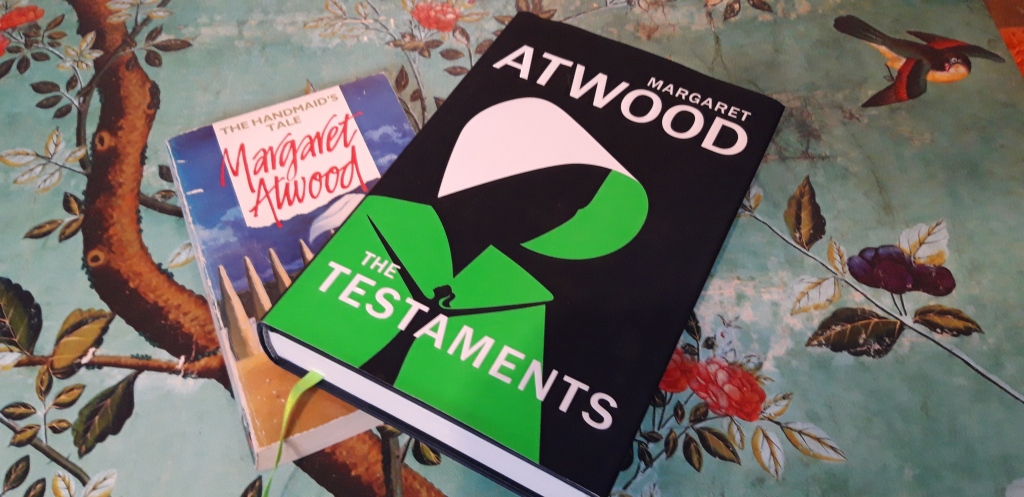
It’s probably safe to say that the appearance of The Testaments has been the publishing event of 2019 in the UK, the USA and Canada. Here in London the launch in September garnered huge publicity, with branches of Waterstones bookshop remaining open so that Atwood super-fans could grab themselves a copy at midnight on 10 September.
Perhaps the excitement was sparked by the success of the television adaptation, starring Elizabeth Moss. I had watched the first season (based on The Handmaid’s Tale), but not the second (which diverges from that story), so I didn’t have a problem in adjusting expectations slanted one way or another by the TV series in another direction when reading The Testaments, which is not based on events in the televised drama (reminiscent of the situation that surrounded the most recent Bridget Jones book and movie).
A good friend was heavily involved in the production process for The Testaments, so I was pleased to learn of Margaret Atwood’s UK Booker Prize win in October (a win that was shared equally with Bernardine Evaristo, for her Girl, Woman, Other). Nevertheless, the decision to split the prize has attracted controversy, especially given Atwood’s acknowledgement that she doesn’t much need the publicity, with the book selling 250,000 copies across all formats within a couple of weeks.
I hadn’t read the Booker shortlist in full. The only other two books I’d managed to get to were Salman Rushdie’s Quichotte and Elif Shafak’s 10 Minutes, 38 Seconds in this Strange World, neither of which matches, for me, the pull of The Testaments.
The Testaments‘ main plus is that it is wildly readable, much more so, strangely, than its predecessor, The Handmaid’s Tale (published in 1985), which drags in places. And it is terrifying in both the extent of the world imagined by Atwood, and in the hideous plausibility of that world. Known as Gilead, it is an extreme form of puritan theocracy, stretching across swathes of the former USA.
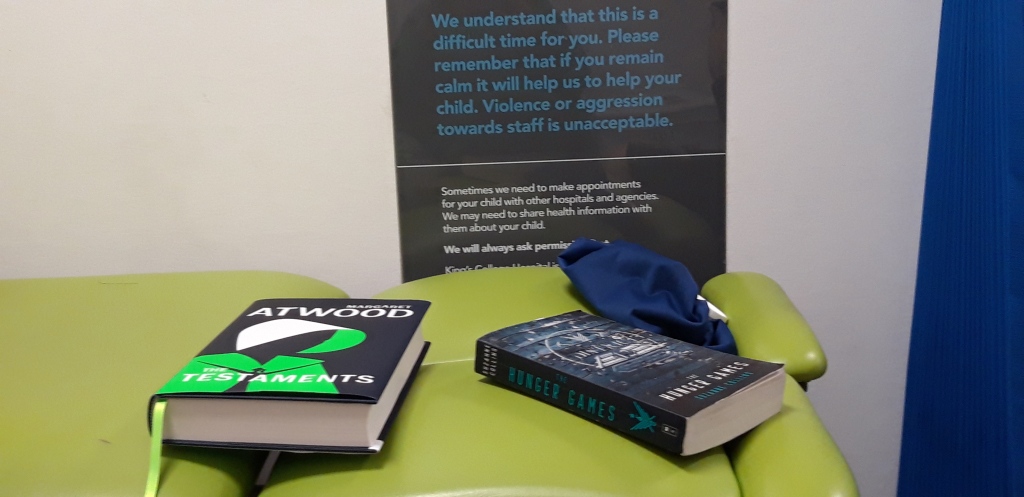
I really enjoyed the book, which even accompanied me to the hospital accident and emergency department when my 12-year-old daughter injured her leg (she coincidentally was also deep into her own dystopian read – the omnipresent Hunger Games).
Set some 15 years after the events of The Handmaid’s Tale, The Testaments is an engrossing piece of storytelling, with some interesting juxtapositions: there are moments of culture shock, as a character enters Gilead from modern-day Canada, and is non-plussed at the bizarre and strangely medieval practices that are the norm in the patriarchal state, where women are uncompromisingly repressed and oppressed.
We get a wider perspective than was the case with The Handmaid’s Tale, with testimony from the terrifying Aunt Lydia on the foundation and operation of Gilead, even if her mode of delivery, a secret written testimony, is sometimes implausible and a bit clunky:
“This morning I got up an hour early to steal a few moments before breakfast with you, my reader. You’ve become somewhat of an obsession – my sole confidant, my only friend – for to whom can I tell the truth besides you? Who else can I trust?”
The book is also something of a coming of age novel (I think it’s time for me to step away from the coming of age novels, as I seem to have read a glut of them recently). It focuses on events in the lives of a small number of teenage girls, who represent the first generation to have been brought up in Gilead, where women are limited to a small number of roles: high-status Wives, low-status Econowives, fertile Handmaidens to produce children for the often infertile Wives, Pearl Girl missionaries and autocratic, celibate Aunts.
In the final third of the book all the threads begin to come together, and a bit of humour creeps into the narrative, as well as real jeopardy. Plot-driven, it reads at times like a mash-up between Philip Pullman’s La Belle Sauvage and a US buddy movie.
I liked Atwood’s quietly profound, snappy phrases (“Nobody is any authority on the fucks other people give”) and clever little details, like the discovery that Aunts are named for reassuringly familiar (to the older generation, at least), female-orientated, defunct commercial products: Aunt Maybelline, Aunt Estée, Aunt Dove.
I’ll forgive The Testaments for a few startling coincidences, which serve to keep the action moving. I particularly liked the nods to modern political phenomena, such as references to those in authority resorting to accusations of ‘fake news’ to defend themselves. Hmm, sounds strangely familiar.
The book’s acknowledgements section comes with the reminder that nothing takes place in the novel that is unheard of in human history, shaking up our “it could never happen here” complacency. Let’s face it, modern life sometimes doesn’t feel that far from dystopia…
This new release (2019), directed and co-written by Alejandro Landes, is like Lord of the Flies on shrooms.
Monos is an exciting, visceral and disturbing film, which has been selected by Colombia as its entry for the upcoming Oscars in the category of International Feature Film. In October 2019 the film also won the prize for best film at the official competition of the 2019 British Film Institute (BFI) London Film Festival.
Eight tooled-up teens linked to the shady ‘Organization’ camp out in filth on a misty, rainy South American mountain top, keeping tabs on an American hostage known only as Doctora, and supplied with milk from a conscripted black and white cow called Shakira.
Subjected to a tough, intermittent training regime under the mysterious, diminutive and hard-bodied ‘Messenger’, when they kick back, they really kick back. The 15th birthday of one teen (with the nom de guerre Rambo) is celebrated with a ritual beating. This is followed, when darkness falls, by hedonistic, tribal scenes, reminiscent of a 90s squat rave, which at times took me right back to a typical night out circa 1998; even the cow has glow sticks. After Shakira is accidentally shot dead, however, events, already undercut with danger, take an increasingly darker turn.
The film is elemental, with scenes of the child soldiers looking down from their mountain top onto expansive, gorgeous, endlessly cloud-filled skies, and miles of rain forest. The soundtrack by Mica Levi is haunting, evoking the fluting whistles of birds, and at times a sort of innocence and at others, menace. The cinematography is often beautiful, and the film builds a claustrophobic sense of threat, laced with sweat, bugs and humidity.
There is minimal dialogue, which works to build up the feeling of disconnection and dread. The action takes place at an undefined time (there is no evidence of mobile phones or computers), so it could just as easily be now or 50 years ago. We never get the teenagers’ back story, and we know very little about the organization of which they form a part (presumably at least tangentially based on the Colombian guerrilla movement FARC), but we do witness rare moments of vulnerability and brokenness, as events spiral. I watched the film subtitled in English, and the Spanish-speaking performances are electrifying, with little-known actors working alongside well-known figures from US movies and TV series, such as Moisés Arias, a former star of Hannah Montana.
The film is definitely worth catching on the big screen if you can, as its power would undoubtedly be weakened if watched in other formats.
I serendipitously found my copy of this book in a secondhand bookshop in Herne Hill, South London, which I’ve found to be an unexpected and excitingly ripe source of obscure works of fiction in translation. The husband – amusingly but perhaps a bit meanly – suggested that maybe someone local is doing the exact same project as me, but is just that little bit ahead…
Our Lady of the Nile by Scholastique Mukasonga rattles along like a Rwandan version of Mallory Towers – until, suddenly, it is chillingly nothing at all like an Enid Blyton boarding school novel. Set in 1979, it follows the school lives of a group of elite Rwandan girls. They attend a prestigious Catholic boarding school, the Notre-Dame du Nil, which is run by nuns.
The opening lines of the book paint a vivid and captivating picture of the institution:
‘There is no better lycée than Our Lady of the Nile. Nor is there any higher. Twenty-five hundred meters, the white teachers proudly proclaim …. “We’re so close to heaven,” whispers Mother Superior, clasping her hands together.
‘The school year coincides with the rainy season, so the lycee is often wrapped in clouds. Sometimes, not often, the sun peeks through and you can see as far as the big lake, that shiny blue puddle down in the valley.’
In the anecdotes about school life – both recognisable to myself as a Brit and not so recognisable – a vibrant picture of the girls lives is built up. The pupils comprise predominantly Hutu girls and a few Tutsi girls attending the school to fulfil a ‘quota’, and as the story unfurls it serves as a microcosm of wider Rwandan society.
As one of the reviews on the book’s back jacket says, “Strangely, it is in this incredibly light novel, that one best understands the ethnic, political, and religious reasons behind the massacre of the mysterious Tutsis.”
I’d never taken the time to fill in how and why the Rwandan genocide took place. And I’m ashamed to say I’d never truly taken in the sheer scale of the atrocities. While reading the novel, I was driven to do some research online to fill in some of my missing Rwandan history.
I learnt that the Tutsis have sometimes been described as “African Jews”, and that perceived differences and societal divisions between the majority Hutu and minority Tutsi populations were reinforced by Rwanda’s Belgian occupiers. Influenced by the European eugenics movement, the Belgian colonisers favoured the Tutsi population, considering their lighter skin to indicate Caucasian heritage. As a consequence, Tutsis were often rewarded with political clout and senior positions in the colonial regime.
Anti-colonial and anti-Tutsi movements began to emerge. Rwanda was declared a republic in 1961, and the monarchy was abolished. Independence from Belgium followed in 1962. In April 1994 the highly symbolic murder of Tutsi Queen Gicanda (who had been living “locked up in her Butare villa” for years) took place towards the beginning of what later became known as the Rwandan genocide. The novel is set almost equidistant in time from these key events, and deep ethnic tensions are evident even in the rarefied atmosphere of the lycée.
Mukasonga’s novel was first published in 2012, and appeared in English translation in 2014. It won the Prix Renaudot in 2012. The copy I read is published by US publisher Archipelago books, which describes itself as a “not-for-profit press devoted to publishing excellent translations of classic and contemporary world literature.” Recently having been voted one of the 100 best books by women in translation, Our Lady of the Nile is a book I’m glad to have chosen to represent a work by a Rwandan female writer.
Translated from the French by Mattias Ripa (Satrapi’s real life husband) and Anjali Singh
Marjane Satrapi’s memoir Persepolis broke new ground, by exploring her experiences during and after the Iranian Islamic Revolution and the Iran-Iraq war of the late 1970s and 1980s, in the form of a graphic novel. Published in the early 2000s, by 2018 it had sold more than 2 million copies.
As Satrapi writes in an Introduction to the book: “Since [the Islamic Revolution] this old and great civilization has been discussed mostly in connection with fundamentalism, fanaticism, and terrorism. As an Iranian who has lived more than half of my life in Iran, I know that this image is far from the truth.”
I ordered my copy from my local Southwark library. Really, it is two books, or even four books, as it includes what was originally published in France as Persepolis I and II (The Story of a Childhood) and Persepolis III and IV (The Story of a Return). I’d taken it out of the library before, but hadn’t got round to reading it, assuming, I guess, that because of its themes it would be heavy-going and hard work. However, once I’d decided I was going to embark on my global cultural tour, I grabbed a copy for the second time – and actually read it. Within just a few pages I was gripped….
….Although my only gripe was that the text is teeny tiny, even with my old-person reading glasses on.
The book is aimed squarely at a Western audience, and is designed to break down stereotypes and challenge misinformation, as well as entertain. Unsurprisingly, the book was banned in Iran. Satrapi herself settled in France in her 20s, although her enduring love for her native country shines out clearly from her writing.
Although I’m not usually a fan of the comic strip format, the device makes the sometimes challenging themes of Satrapi’s story hugely accessible. Satrapi is feisty and funny, describing her experiences of growing up, which veer between the universal and the specific.
Satrapi describes how as a small child her ambition in life was to become a prophet. She believed that she was visited by God, although his pronouncements could be prosaic: “Tomorrow the weather is going to be nice. It will be 75 degrees Fahrenheit in the shade.”
The illustrations, an integral component of the book, are great: evocative and, again, often disarmingly funny. Satrapi is brilliant on facial expressions. Black and white, stark and combining elements of both her Iranian and her adopted cultures, they effectively illuminate Satrapi’s experiences.
Satrapi’s experience in Iran, of course, was in many ways atypical. Her family were part of an educated elite, and had the money to send her to Europe for several years in her teens, to take trips to Europe and Canada themselves, and to pay for Satrapi to move to France to study in her twenties.
So she had a comparatively privileged lifestyle, but that is not to undermine or understate the difficulties Satrapi faced growing up during a time of repression and devastating conflict. And she effectively conveys the horrific toll it took on the people of Iran as a whole. This includes the sudden proliferation of nuptial chambers (as Satrapi explains, when an unmarried shi’ite man dies, a nuptial chamber is built for him so the dead man can, symbolically at least, gain carnal knowledge) and the huge number of streets renamed in honour of fallen ‘martyrs’.
In addition to being a coming of age story and a political memoir, the book is also a tale of familial love. Satrapi’s warm, loving, secular parents were endlessly supportive and caring, and her filthy-mouthed granny is an appealing character (who, incidentally, attributed the pertness of her elderly breasts to a daily 10-minute dip in ice water). Illuminating and entertaining, and a quick read, I wholly recommend this illuminating book.
till 27th October 2019 @ The Royal Academy of Arts, London
EUROPE
Helene Schjerfbeck is described by the Royal Academy of Arts, where her work is on display in the first major UK exhibition of her work, as “one of Finland’s best kept secrets”. This exhibition, of around 65 paintings, is a welcome introduction to an artist who is well-loved in Finland. The exhibition may be relatively small, but Schjerfbeck’s output was prodigious, and she made over 1,000 works of art over her long career.
The stillness and quiet intensity of Schjerfbeck’s work has drawn comparisons with the work of one of my favourite artists, the wonderful Danish painter Vilhelm Hammershøi, who was active at a similar time, although to my mind her work doesn’t match the standard of his.
Schjerfbeck’s precocious talent was acknowledged by the age of 11, when she became the youngest ever student to be admitted to the drawing school of the Finnish art society. Although she travelled, living in Paris, and spending time in St Ives in the UK with artist friends (the gorgeous realist painting below, Portrait of a Girl was produced there in or around 1889), Schjerfbeck spent the greater part of her life in Finland.
Schjerfbeck’s life does not appear to have been chock-filled with happiness. She spent some years caring for her elderly mother, though they are understood to have had a bumpy relationship. Her own health suffered from the legacy of a childhood accident, which left her with chronic pain. She never married although she evidently wanted to – she was briefly engaged to a Parisian man who devastatingly left her; and seems to have had a massive crush on her 34-year-old friend Einar Reuter, whom she met at the age of 53. Schjerfbeck painted a sensuous portrait of Reuter as a bare-chested sailor (he wasn’t a sailor). Unfortunately her feelings weren’t reciprocated, or if they were, not for long, and Reuter married someone else, the news of which Schjerfbeck feared might kill her.
Schjerfbeck’s style varied widely. She enjoyed painting portraits, and she was very interested in fashion, subscribing to Parisian sartorial publications. As exemplified by the nautical painting of Reuter, she liked to paint her subjects in roles that they did not inhabit in real life. Her painting The Motorist, depicts her nephew as a debonair young man about town – although he didn’t drive a car.
Perhaps the most affecting room in the exhibition is filled with self-portraits, the first painted at the age of 22, and the last at the age of 83. An early self-portrait, from 1895, appears at the top of this post. The self-portrait below was painted in 1944. As she aged, Schjerkbeck’s self-portraits became more abstracted, revealing, the RA tells us, her “fascination with the physical and psychological effects of ageing”. As she ages, her form becomes blurred, her features hazy: a pictorial representation of breath becoming air. Or maybe her eyes were going.
China/US film The Farewell premiered at Sundance in 2019, and has received glowing reviews. Lulu Wang, who wrote and directed it, emigrated from China to the USA as a child (like the film’s principal character, Billi, played by insanely talented rapper and actress Awkwafina, who also starred in the film adaptation of Crazy Rich Asians). The American scenes are largely in English, but once the action moves to China, the film is subtitled. The semi-autobiographical movie (‘Based on an actual lie’), which is very funny in places, is an ensemble piece, playing on family dynamics and cultural differences.
The premise doesn’t necessarily sound likely to provide fertile ground for comedy. When Billi’s paternal grandmother (her Nai Nai, played by the wonderful Shuzhen Zhao) is diagnosed with terminal cancer, Nai Nai’s sons’ families arrive en masse from the USA and Japan to her home in China, but the sons refuse to let Nai Nai know that she is dying. Instead, an extravagant wedding celebration is hastily arranged for Billi’s Japanese cousin, and his more or less mute (non-mandarin-speaking) wife-to-be.
Feisty Billi, who, although a fluent mandarin speaker, is culturally very much assimilated into US society, finds the decision to keep her Nai Nai’s diagnosis secret morally dubious. Billi’s Western and Eastern identities come into conflict with each other, and she struggles to reconcile them. At one key point in the film her paternal uncle sums up the dichotomy:
“You think one’s life belongs to oneself, but that’s the difference between the East and the West. In the East, a person’s life is part of a whole.”
Amid the drama, many of the funniest moments come from the near-universal, and therefore hugely relatable, experience of dealing with relatives who are simultaneously hugely irritating and a source of security and profound joy.
This emotionally intelligent and ultimately heart-warming film is a captivating and highly entertaining exploration of love, cultural identity and empathy.
Translated from the Danish by Tiina Nunally (vols 1&2) and Michael Favala Goldman (vol 3)
Penguin Books recently published Tove Divletsen’s autobiographical Copenhagen Trilogy as a beautiful three-volume set, entitled Childhood, Youth and Dependency (in Danish Barndom, Ungdom and Gift). They are gorgeous editions, and a pleasure to own, but it is a little contentious to have published the collected work as three individual books (each retailing for £9.99 at full price), as each edition is very slender, with the first, Childhood, coming in at just under 100 pages. Being a pedant, I also found it a little annoyingly non-uniform that the penguin logo on the spine is much smaller on the first volume than on the other two. But these memoirs are just wonderful!
I hadn’t previously heard of Tove Ditlevsen, although in Denmark she is apparently a household name, whose work is widely taught in schools. Ditlevsen was a poet and novelist, although much of her other work is sadly not yet available in translation. Indeed, this is the first time that the full set of her memoirs has been made available in English.
I expected that the writing would be a little bit old-fashioned, quaint and maybe hard work. However, the tone is approachable, and the writing felt so fresh that the books could have been written yesterday … apart from the fact that the Copenhagen depicted here is under Nazi occupation for a time.
Ditlvesen is a born writer:
“I’m odd because I read books … and because I don’t know how to play.”
And when Copenhagen is liberated from the Nazi occupation she notes:
“We dance, celebrate and enjoy ourselves, but this historic event doesn’t really penetrate my consciousness, because I always experience things after they’ve happened; I’m rarely in the present.”
As I progressed through the books I fell in love with the voice in these memoirs. I had read of Ditlevsen’s death from an overdose, and imagined depression would emanate from the pages – like the feeling you get from reading Sylvia Plath’s journals. But Ditlevsen is drily witty, and I found her writing so open and appealing that I felt she was someone I would have liked to have as a friend.
Nevertheless, the tone of the first book does sometimes veer towards pathos in its evocation of Ditlvesen’s seemingly endless childhood, growing up in poverty with a harsh mother, a golden older brother, and living in a family that dismisses as foolish her determination to be a writer:
“Childhood is long and narrow like a coffin, and you can’t get out of it on your own.”
“Whenever I walked down the street or stood in shops, I always looked with a mixture of joy and envy at mothers who held their small children in their arms or caressed them. Maybe my mother had done that once, but I couldn’t remember it.”
However, the tone is much lighter in the second book and in earlier parts of the third volume, and Ditlevsen’s accounts of late adolescence and early adulthood are often great fun. There were several times when I laughed out loud at Ditlvesen’s clumsy and engaging navigation of adulthood, her efforts to hold down jobs and find a publisher for her poems, and her deadpan accounts of her often tumultuous relationships.
“The next morning Ebbe comes home in terrible shape. His jacket is buttoned crooked and his scarf is all the way up to his eyes, even though it’s spring and mild weather … He stands there swaying in the middle of the floor and does a few awkward steps of the ‘baboon dance’, a solo dance he always does at a certain point in his drunkenness, while everyone around him claps.”
Ebbe is Ditlvesen’s charming but feckless second husband, who she falls for after embarking on a short-lived marriage to undeniably useful, somewhat elderly, and vaguely creepy editor Viggo.
Dependency, the third volume of the Ditlevsen’s memoirs, and the one part never to have appeared in English before, is her master work, but you definitely benefit from having read the two earlier volumes. By the time you reach the third book, you have come to know Ditlevsen so intimately that the unswervingly described account of her marriage to the controlling and – quite literally – toxic doctor, Carl, packs an emotional punch.
In Danish, the title of the third book, Gift, translates as ‘marriage’, but also ‘poison’, and that double meaning is cleverly retained for the English translation, Dependency. I gasped aloud at some of Ditlevsen’s experiences during her transformation into an opioid addict. She vividly depicts the horror of life at the mercy of addiction, and the incessant difficulties that come hand in hand with recovery: Ditlvesen’s visceral account of her life as an addict is probably the most enlightening account of drug dependency that I have ever read.
But she never loses her wit, such as this darkly amusing account of a dinner with Evelyn Waugh:
“When I asked him what brought him to Denmark, he answered that he always took trips around the world when his children were home on vacation from boarding school, because he couldn’t stand them.”
I’d have loved to have known what became of Ditlevsen’s own children, but the one biography I tracked down is still only available in Danish. I really hope more work by and about Ditlevsen becomes available in English translation. Her writing is some of the best I’ve read this year – and I read a lot!
This is a short sharp shock of a book, a hallucinatory horror story that builds up a constant hum of excruciating tension over its 150 pages.
Published in Spanish as Distancia de rescate (Rescue Distance), the modern gothic, body-swap novella is apparently inspired by Argentina’s environmental problems, and is probably best consumed in one suspenseful sitting.
In 2017 Samanta Schweblin was featured on the second Bogotá39 list, featuring the best 39 Latin American authors under the age of 39. Fever Dream appeared in English translation in the same year, and instantly received a lot of attention. It was shortlisted for the Man Booker International Prize in 2017 and won the Shirley Jackson Award for best novella in the same year. Schweblin had already won the Spanish language Tigre Juan award in 2014, the book’s initial year of publication.
I first heard of Fever Dream via social media. Then during August – since 2014 also known as Women in Translation (WIT) month – I saw that it had been included at number 3 on a fascinating list of the 100 best books by female writers in translation compiled by the founder of WIT month. I decided the time had come to get hold of a copy.
Fever Dream opens with a woman, Amanda, lying incapacitated and mortally ill in a hospital bed, with a boy sitting by her side, whispering into her ear. He “explains” that:
“It’s the worms. You have to be patient and wait. And while we wait we have to find the exact moment when the worms came into being.”
So Amanda begins to run through her memory of the events leading up to her arrival in hospital, starting with her meeting with the boy’s mother, glamorous gold-bikini-wearing Clara. Clara lives next door to Amanda’s holiday rental, where she is staying with her almost preternaturally self-contained and mature little girl, Nina, who sweetly carries around a giant stuffed mole.
A sense of foreboding surrounds references to the little girl:
“Where is Nina now, David? I need to know.
Tell me more about the rescue distance.
It changes, depending on the situation. For example, in the first hours we spent in the vacation house, I wanted Nina close by at all times. I needed to know how many exits the house had, find the areas of the floor with the most splinters, see if the creaky stairs posed any danger … So the rescue distance is important?
Very important.”
The screw tightens, and as Amanda searches her memories to piece together events the boy sometimes stops her:
“This isn’t the exact moment. Let’s not waste time on this.
Why do we have to go so quickly, David? Is there so little time left?
Very little.“
I don’t always find lists that seek to establish some kind of canon to be the best places to find new reads. Like prize lists they can be problematic and subjective (my recent bad – so bad! – experience with Salman Rushdie’s Quichotte being a case in point). However, in this case Schweblin fully deserves the plaudits, and I’d be interested in reading more of her work … when I’ve got through the remaining 375 or so books I need to work through for this little project/life sentence (see the full list at https://readingandwatchingtheworld.home.blog/the-countries-by-region). If you have any suggestions or recommendations do get in touch!
Exhibition @ Tate Modern, London, UK from August 2019 until July 2020
EUROPE
“Generally I am not as interested in the finished work as I am in the way it comes about, which is to say the question of realising a task that I have set myself, the idea” – Dora Maurer
I went to Tate Modern recently to see an exhibition of the work of Hungarian artist Dora Maurer, which is on display until next summer. Maurer was born in Budapest in 1937, and the exhibition highlights work from the 1970s onwards. During the course of her long career she has made use of a wide variety of media, including photography, video, painting and sculpture.
Maurer emerged as an experimental, avant garde artist, whose work ran counter to that sanctioned by the state-sponsored socialist orthodoxy in place around her at the time. She trained as a graphic artist and printmaker, and also worked as a curator and teacher.
The early work demonstrates her enduring obsession with movement and geometric composition. I found the microscopic focus on mathematical precision, and the effect of minute tweaks to angles and poses a little challenging, and not easy to interpret. What comes out of this exhibition though is a real sense of enjoyment in the thrill of creation, and deep engagement in the process of making her art.
One room is dedicated to video work, including a hypnotic triptych of films, entitled Triolets. The spliced together videos move mechanically from side to side to a wordless female warble. This work demonstrates Maurer’s long-standing curiosity about the nature of repetition, movement, perspective and perception, and what she has termed ‘displacement’. It also exemplifies her interest in the effect of music on these processes in her art. (And caused two of my children separately to remark “why are you listening to cult music?” as I played the video back on my phone.)
My companion at the exhibition (let’s call her ‘the redhead’) noted similarities to Bridget Riley in Maurer’s later work, which was much more boldly coloured, as she moved away from black and white. She experimented with layering colour, watching it change in the light and, as ever, subverting perceptions, here through anamorphosis.
This work, using acrylics and titled Projected Quasi Images, was commissioned in the 1980s by collector Dieter Bogner for the walls of a Viennese castle, and it reminded me a little of the old Transport for London seat covers (though not in a bad way). However, if Maurer’s work sometimes has a familiar, even derivative feel, with a career dating back to the 1960s, it is quite likely that her ideas preceded or inspired those of others rather than vice versa.
Later her focus on colour became even more profound, as her interest grew in “the way colour behaves, its vibrations and imaginary movements” (art historian Dávid Fehér). The most recent series, developed during 2007-16, which explores colour and rhythmical, three-dimensional movement, has been described by Maurer as ‘form gymnastics’. The example below is one of her Overlappings paintings.
The exhibition does not seem to have been widely publicised, but is well worth a visit, and there is no charge for entry.




 Imogen is Reading and Watching the World: On Books, Film, Art & More