Review no 116: The Transmigration of Bodies by Mexican author Yuri Herrera

AMERICAS AND THE CARIBBEAN

Translated by Lisa Dillman

This novella, first published in 2013, and published in English translation by And Other Stories in 2016, comes in at barely 100 pages, so I was able to read it in a single day. Set during a mysterious mosquito-borne pandemic, I found it to be a comically noirish gangland tale of rival families, faintly resonant of Romeo and Juliet or West Side Story crossed with a bit of Raymond Chandler.

Our (anti-)hero, known as The Redeemer, is a gritty, hard-boiled fixer, a sex-obsessed alcoholic and depressive, who works for someone known only as the Dolphin (because, it seems, he’s full of holes, both from being shot and from wearing out his nose with “too much blow”). The Redeemer becomes embroiled in an enterprise to, as it were, repatriate the bodies of two dead (just about adult) children, each of whom has died while in the hands of one of the enemy families, the Costas and the Fonsecas.

The story read to me like a pastiche of noir fiction, since these gangland tropes are so familiar. The book’s use of language is quite often ridiculous, though extraordinarily inventive and read-out-loud entertaining. One bruiser is described as walking “like he was forever on his way out of the ICU, moving each muscle with considerable care“. Peak stupid quote though was when the Redeemer thinks “Talk and cock is all I got … And sometimes fear.” What a tit!

All the characterisation is fairly thin, but that doesn’t matter because the book doesn’t seek to provide well-developed characters. It’s very testosterone-driven, and most of the female characters are either dead, drunk or simply fun in the sack. After reading this book, you do find yourself using phrases like “fun in the sack”.

The Redeemer’s paramour is known only as Three Times Blonde – we’ll leave it to the imagination as to why that might be. He doesn’t know her name and she doesn’t know his, but that doesn’t stop them – maybe it’s a bonus! – and the plot is inter-spliced with fairly, erm, graphic sex scenes. (Writing this review seems to be making me even more uncomfortably British than usual.) I should make it clear, too, that I’m not really criticising the book for its female stereotyping, since the men are all ciphers too…

Some of the imagined context of the novel has become familiar to us as part of everyday life during a pandemic: people are told to stay indoors, but not panic, and “it was terrifying how readily everyone had accepted enclosure.” Mask-wearing has become ubiquitous, with runs on pharmacies, people sneeze into their elbows rather than their hands and there’s an amusing scene set in a strip club, where: “One girl was dancing before a cluster of liquored-up fools, naked but for the mask over her mouth; each time she leaned close she made as if to take it off, and the boozers whooped in titillation.”

Like a fever dream, this high-octane tale spun out kaleidoscopically before my eyes, but I’m fairly certain I’ll struggle to remember much about it in a week’s time. I’m pleased, though, to have ticked this one off my massive list of unread books for week 3 of Novellas in November (#novnov).

Review no 115: A Month in Siena by Hisham Matar

LIBYA – NORTH AFRICA, MIDDLE EAST, CENTRAL ASIA AND THE SOUTH CAUCASUS

Published by Penguin, 118 pages

“In the end, as it is in the beginning, love and art are an expression of faith. How else to function with the limited knowledge we have? … the whole history of art can be read as that: a gesture of hope and also of desire, a playing out of the human spirit’s secret ambition to connect … to traverse that tragic private distance between intention and utterance, so that, finally, we might be truly comprehended … to be seen, to be recognized, not to be mistaken for someone else, to go on changing while remaining identifiable to those who know us best.”

A Month in Siena is a slender work of non-fiction, which I had been planning to read, a decision hastened by the knowledge that many book bloggers have been reading ‘non-fiction novellas’ as part of Novellas in November (#novnov), encouraging engagement with other book-obsessed people (and especially valuable at a time during the global pandemic when life’s ‘real world’ experiences have narrowed so much!).

I really like Hisham Matar. His writing is lucid and engaging and vivid, and I have read a lot of his work. I would love to meet him, though he is much more erudite than me, so we probably wouldn’t get along. For example, he has impressive conversations with his wife Diana about the overlaps and contrasts inherent in the meaning of the terms “freedom” and “assertiveness”. My husband and I do not have conversations like that (probably for the best).

I started reading Matar when my son was tiny, with his pacy novels, literary political thrillers really, In the Country of Men and Anatomy of a Disappearance. Later, when I read his memoir The Return: Fathers, Sons and the Land in Between (which won the Pulitzer Prize for Biography), I learned how much of his fiction was informed by his own experiences, and how he lives with a devastating, uncertain void where his father used to be. He is brave, or more accurately resilient, in that way that people who’ve been marked by life’s tragedies can be. I think it comes from the brutal reality of having no choice but to cope, together with a determination to seek out the beauty in life while never seeking to deny its horrors. (As an aside, I vividly remember a counsellor saying to me after my daughter was born very ill, having been diagnosed with a lifelong disability caused by a fetal stroke just before birth, that she thought the families of disabled children were “brave”. Irritated by her unhelpful platitudes I left and found a new counsellor…)

Matar has had, in so very many ways, a difficult life. He was born in the USA to comfortably-off Libyan parents during a diplomatic posting. However, on returning to Libya, Matar’s family were ultimately forced to flee the country. His father was a prominent dissident leader and a wanted man, amid the upheavals that ushered in the Qaddafi regime. The family were therefore dispossessed and exiled for much of Matar’s childhood, and at one point he didn’t return to Libya for some 30 years; growing up, Matar’s father would check the car for concealed explosives before allowing his family to get inside, and travelled under a pseudonym.

Matar writes that, in 1990, while studying in London, he became obsessed with the Sienese school of painting, spanning the 13th to the 15th centuries. This interest seems to have provided a means of coping with the trauma of the disappearance of his father, with which it coincided:

I had lost my father that year. He had been living in exile in Cairo, and one afternoon he was kidnapped, bundled into an unmarked airplane and flown back to Libya. He was imprisoned, and gradually, like salt dissolving in water, was made to vanish

Occasional letters reached the family from prison, but after 1996 there was only silence. The overthrow of the Qaddafi regime led to no answers, only more questions, as discussed in The Return. In middle age, and following the completion of The Return, Matar’s trip to Italy, to Siena, is on the surface inspired simply by his enduring love of Italian art from a particular place and time. He rents a flat that forms part of an old palazzo, with frescoes and beautiful proportions.

The place reminded me how the buildings we encounter, like new people we may meet, can excite passion that had until then lain dormant … [demonstrating] the transformative possibility of crossing a threshold

He discusses time spent wandering the city with his wife, the beauty of that and of the paintings he sees, and along with accounts of these experiences provides profound insights into the nature of art and the human condition. After his wife’s pre-agreed departure, Matar’s forges connections with local people, discovers treasured vantage points, and becomes familiar to gallery staff. The realization comes that:

“I had come to Siena not only to look at paintings. I had also come to grieve alone, to consider the new terrain and to consider how I might continue from here.

This is an intensely intelligent, beautiful and humane little book, which, ultimately, is much more than the sum of its parts.

Review no 114: Artist Kasimir Malevich (1878-1935)

UKRAINE, EUROPE

I read a lot of non-fiction anyway, but for #nonficnov, and fitting in with the general theme of ‘time’, I finally read in its entirety a fascinating book called Lost Art, edited by Jennifer Mundy, and published by Tate. Informative, often poignant, the book examines artists whose work has been ephemeral in some way: maybe stolen, or destroyed, or lost, or perhaps always intended to be transient, as with Christo’s Wrapped Reichstag, which I discussed earlier this year.

Kasimir Malevich’s lost work appears in the section labelled “Missing” – as has been the fate of so much work produced in the first decades of the 20th century – and inspired me to look into the artist a little more.

Influential pioneer of abstraction Malevich was born in what is now Ukraine in 1875. By 1912, influenced by work elsewhere in Europe, he was painting in a so-called Cubist-Futurist style. Malevich’s focus on the emotional power of art, rather than its representative use, subsequently led directly to the evolution of the Suprematist movement, and its obsession with strong lines and simple shapes. He subsequently went on to produce the works for which he is now most famous, Black Square (1913) and White on White (1918), reproduced here and here.

Tate gives a useful guide to the importance of Black Square (the blackest of black squares on a white background), which was exhibited amid the febrile tensions of the First World War, here.

Trying desperately to free art from the dead weight of the real world, I took refuge in the form of the square.”

With White on White the square has lost any sense of materiality, and merges into the ether, therefore seemingly taking abstraction to its furthest frontier. Later in the decade, other Suprematist works by Malevich increased in complexity, introducing more shapes in more complex arrangements.

Black Square has survived, along with many of his abstract works, even if the paint is now cracked and faded. In contrast, the particular work referenced in Lost Art couldn’t be more different, and shows evidence of Malevich’s early (and consistent) interest in folk art and the rural farmland in which he grew up, as well as his continuing interest in the depictions of the human condition produced as part of the European modernist movement.

The enormous, figurative, by then highly unfashionable painting Peasant Funeral (1911) – see below – accompanied Malevich to Germany in the mid-1920s along with many of his other works, as his art fell out of favour at home, and the artist, who had been appointed Director of the State Institute of Artistic Culture, came under suspicion by the state under Stalin. Malevich was subsequently ordered to return the Soviet Union, where his artistic freedom was restricted and where he died in 1935, having been unable to seek cancer treatment abroad.

Much of his work, however, which he had exhibited in Western Europe, remained in Berlin for safe keeping, and fortuitously survived the Nazi purges of “degenerate” art; however, Peasant Funeral (together with several other large pieces) disappeared, and remains missing, presumed destroyed, its only surviving depiction a poor-quality photograph that accompanied a review of the work in 1912.

[Photo taken from the book Lost Art edited by Jennifer Mundy (published by the Tate in 2013).]

Cultural Plans for November 2020

My usual reviews of world culture resume later this week.

Meanwhile, this month seems to be a month of reading challenges. Luckily (in this one very small sense at least), we have a month of lockdown in the UK, and I’m also on holiday from work for some of it, with nowhere to go.

Books

Peak book nerdery: Books sorted into vague categories, with overlapping ones applicable to more than one 🙂

For Novella November (#novnov), hosted by @bookishbeck and @cathy746books, I’ve selected:

  • Weather by Jennifer Offill – I loved the Debt of Speculation and am looking forward to this. ☑
  • A Month in Siena by Hisham Matar (non-fiction, so I guess not technically a novella, but it is short! – on Kindle so not pictured in my photo) – a memoir by the prize-winning author, ostensibly about looking at paintings in Italy. ☑
  • A Life of One’s Own by Marion Miller – a bit of a random find, mentioned in an art book I read, published in the first part of the 20th century, it’s an account of a seven-year personal journey to discover what it is that makes her (and maybe us!) happy.
  • The Transmigration of Bodies by Yuri Herrera – dystopian/speculative fic from Mexico. ☑
  • Good Morning, Midnight by Jean Rhys – the classic tale of drifting and drinking in Paris. ☑
  • A Doll’s House by Henrik Ibsen – recommended by my daughter who’s doing this for A level. ☑

For Nonfiction November (#NonfictionNovember, #Nonficnov), hosted by a few people, I think @shelfaware, @abookolive, @julzreads, @doingdewey, and @what’snonfiction, I’ve selected:

  • Lost Art edited by Jennifer Mundy – discusses many works of art that have disappeared, been destroyed or simply been intended to be transient, predominantly over the 20th century, with a couple of pages dedicated to each work or artist. ☑
  • A Month in Siena by Hisham Matar (doubling up!) ☑
  • The Five by Hallie Baillie – buzzy social history about the victims of Jack the Ripper.
  • A Life of One’s Own by Marion Miller (also doubling up)
  • Modern Nature by Derek Jarman.

For Reading Australia month (#AusReadingMonth) hosted by @Brona’sbooks I have:

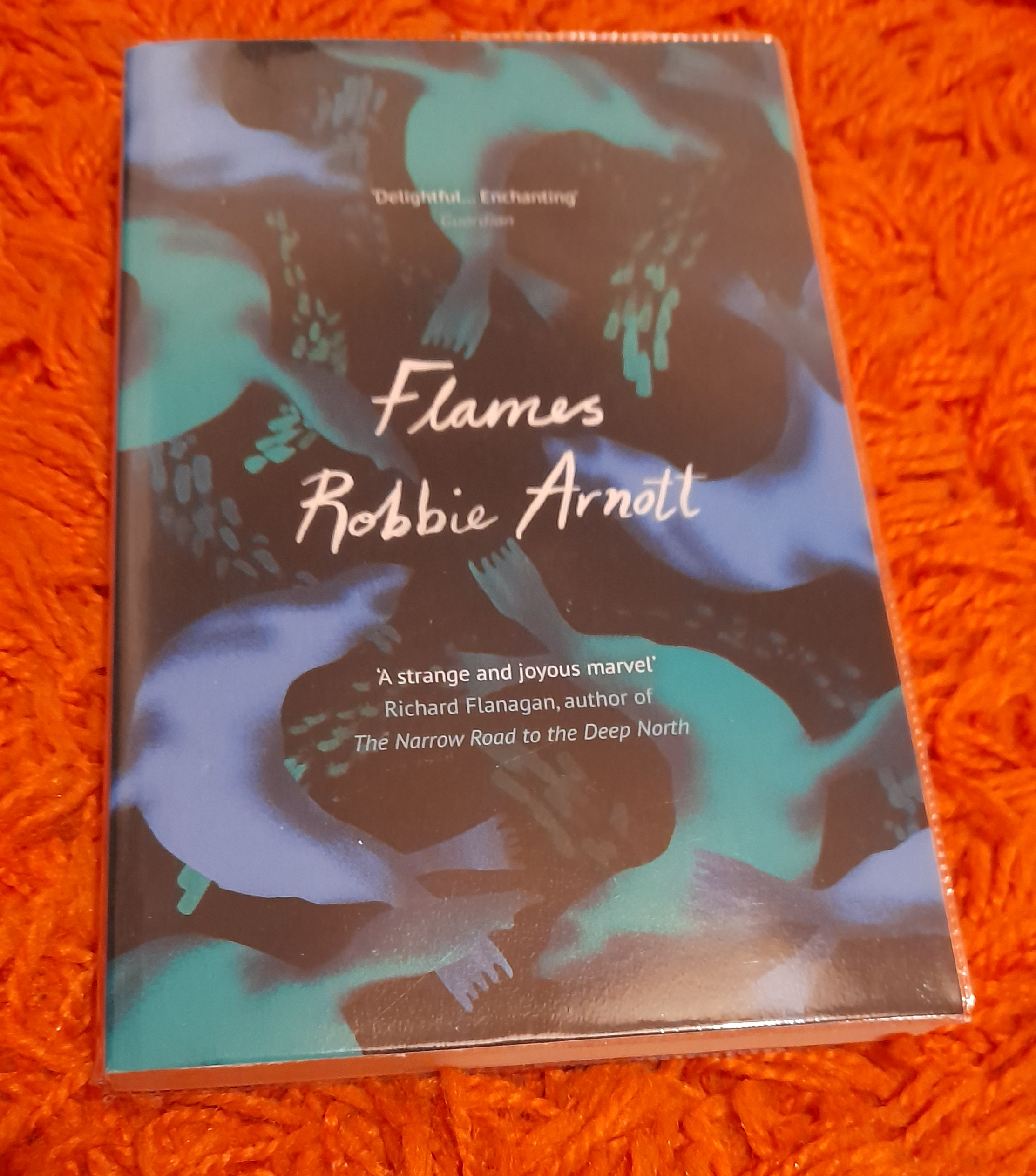
  • Flames by Robbie Arnott, described as “a mad, wild debut novel, roughhewn from the Tasmanian landscape and imbued with the folkloric magic of the oldest fireside storytellers”. ☑
  • Their Brilliant Careers by Ryan O’Neill (recommended by my friend David), described as “a satirical, funny alternative history to Australian literature” (which could also work for Nonfiction November).

For German Lit Month (#germanlitmonth) hosted by @lizziesiddal I have:

  • You Should have Left by Daniel Tyll (not pictured, as it’s in the post!) which sounds like a psychological/gothic horror with a touch of The Shining about it.

For Margaret Atwood Month (#MARM) I have:

  • Hagseed by erm Margaret Atwood, a retelling of The Tempest.

And additionally I have:

  • The Women by T C Boyle, a fictionalised account of the personal life and colourful love life of the architect Frank Lloyd Wright.
  • The Authenticity Project by Clare Pooley (for my RL book club, not that we can meet up, and zoom just reminds of bloody work meetings) – described as the “feel good read of 2020”.

plus two audio books:

  • Small Pleasures by Clare Chambers: a light novel, about an apparent virgin birth. ☑
  • Ramble Book by Adam Buxton “Musings on childhood, friendship, family and ’80s pop culture” by the very funny if faintly narcissistic Buxton, who’s also a massive Bowie fan like me.

If I get through all these it’ll be a miracle, but we’ll see!

Filmwise, I’m absorbed in the Africa in Motion Film Festival 2020, and in terms of art I’m making a last-minute pre-lockdown trip to Tate Modern, and flicking through photography books. I also have a shiny new bike that I’ll be taking to the park, if my bad shoulder permits.

Also watching telly with my tween and/or two teens (currently on the Simon Pegg/Nick Frost vehicle Truth Seekers, after whipping through a couple of series of Misifts from around 2010 – but we’ve lost conviction now we know the fabulous Nathan, played by Robert Sheehan, leaves in season 3 – and also loving Bake Off and Taskmaster for cosiness and laughs).

Review no 113: Dhalinyaro (Jeunesse or Youth), a film from Djibouti

NORTH AFRICA, MIDDLE EAST, CENTRAL ASIA AND THE SOUTH CAUCASUS

in Somali and French with English subtitles (2019, running time 1hr 25 mins)

As part of the Africa in Motion film festival 2020, which ran from 30 October until 29 November 2020, I watched this online screening of the 2019 feature Dhalinyaro, directed by Lula Ali Ismail.

The film follows the lives of three girl friends, Asma, Hibo and Deka, throughout their final year of school in Djibouti city. The film is beautifully filmed, and I loved the insights into life in Djibouti, the bustle of the city and the port, the beautiful sands of the beach, the rolling waves and the sharply contrasting lifestyles of the three girls.

The film is set in contemporary society, where mobile phones and laptops are ubiquitous, and which seems to mix conservatism with opportunities for self-development. As well as taking their BAC exams (the International Baccalaureate), the girls have to make decisions about their future, and if money permits they are encouraged to travel to France to pursue their university studies (as Asma notes, funds for further studies, for her, are “rare as snake’s shit”).

This is the second African film I’ve seen lately that discusses study in France as a natural progression from schooling in a francophone nation (although looking online it seems that illiteracy is fairly common in parts of the country). I had no idea that travel to France was such a rite of passage for so many middle-class francophone Africans. Watching African films, it also interests me how the dialogue often switches between languages (here between French and Somali), and whether there are informal societal rules governing this (I did study linguistics at university back in the day so maybe this explains my geeky interest!).

The story itself is gently paced and doesn’t break any new ground: it’s a straightforward coming of age tale, but no less charming for that. It opens with wealthy, appearance-orientated Hibo (who typically sweeps around in a chauffeur-driven four-by-four), sobbing in the school bathroom as she miscarries – a shocking and scary experience that has coincided with Eid. Asma and Deka do not judge, but lend her a black abaya to cover her blood-stained trousers and swiftly and stealthily arrange her a taxi to the hospital. From then on the three are inseparable.

The movie is the first to be made by a female director from Djibouti (and Lula Ali Ismail also has a cameo role as the girls’ school teacher), and it provides a convincing, character-driven exploration of friendship and the challenges and pleasures of youth.

Best reads – October 2020

I’ve read quite a lot this month and seen a ton of films, despite work being frantic for most of the month. I guess it’s down to the fact that we’re still staying close to home and not seeing many people due to the “second wave” (though surely it’s more a resurgence of the first wave?) and to the awful wet and cold weather we’ve been having in London.

My top three reads of the month, though, don’t fit my criteria for their own blog post, but are worth a mention.

Dear Reader by Cathy Rentzenbrink (UK) discusses the benefits of reading for dealing with life’s ups and downs, whether outright trauma or just the daily grind. It’s a mix of memoir and recommendations, and I really liked it. She’s read a lot of the same books as me, but she also signposted me to several I haven’t read, and she’s read across a large range of genres and styles. It’s newly published – I got my copy from the recently (sort of) reopened library.

Sisters by Daisy Johnson (UK) is also newly published, a creepy Gothic chiller by the youngest writer ever to be shortlisted for the Booker prize. It’s a quick read, and rapidly very gripping. Her writing is beautiful, though it reads a bit like she’s gone through a list of Gothic tropes and ticked them off as she goes along :).

Finally, my favourite read in October was T. C. Boyle’s Outside Looking In (USA), a fictionalised (but well-researched) look at the communal living experiment instigated by Timothy Leary and his followers in the 1960s. This book really sucked me in, and I couldn’t put it down. Boyle is very good at evoking the hallucinatory experience (it brought back the 90s for me) and at convincingly communicating the dangerous allure of a bucket-load of charisma combined with a devil-may-care attitude. This book certainly doesn’t glorify LSD in any way, but is enormously entertaining as well as interesting on the ‘philosophy’ behind the thinking of Leary’s acolytes – and clear too on the potentially destructive power of illicit pharmaceuticals. I’ve now bought Boyle’s The Women, a novel about the turbulent personal life of the architect Frank Lloyd Wright.

Review no 112: The Pear Field by Nana Ekvtimishvili (Georgia)

Translated from the Georgian by Elizabeth Heighway

NORTH AFRICA, MIDDLE EAST, CENTRAL ASIA AND THE SOUTH CAUCASUS

The Pear Field is published in English for the first time by Peirene Press this autumn as part of their ‘Closed Universe’ series of translated literature, which also includes Snow, Dog, Foot by Claudio Morandini, which I reviewed early this year. Of course, since the series was launched, we all feel as though our own personal universes have become a little more closed, which makes the choice of theme seem rather prescient.

Author and film director Nana Ekvtimishvili has set this novel in the Georgian capital, Tbilisi, at a boarding school for children with disabilities, otherwise locally known as the School for Idiots. It seems to be set in the immediate post-Soviet period, and it is immediately evident that this school is not situated within any kind of progressive or enlightened environment when it comes to child care – or child protection.

The dangerous appeal for the children of the so-called ‘trampoline room’ is evoked vividly: a room high up in the school building, filled with ancient decommissioned bed frames, and with a doorway that opens directly into the open air since the time a derelict balcony unexpectedly collapsed to the ground.

The book’s main character is 18-year-old Lela, who has been institutionalised her whole life. She knows nothing about her background, bar the fact that she previously lived in a children’s home, and was moved to the school when she reached the appropriate age for schooling, such as it is.

Life is hard for the children at the school. The conditions are unsanitary, clothes and furnishings are worn and well-used, and the sexual abuse of female children is prevalent. Perhaps owing to the spare conditions, on rare occasions when the school grounds are hired out for weddings, the associated feasts are described in tantalising detail:

The children pile food onto their plates: hot khachapuri, fried chicken, liver with walnuts, vegetable phkali, walnut sauce, clay-baked shoti puri flatbreads and everything else that’s on offer.

The action takes place almost entirely within the walls of the school, with newcomers being the focus of intense fascination. The story moves along in an episodic fashion, as we learn about the children that Lela comes into contact with, as well as semi-mythical tales of previous residents who have moved on, for good or for bad. Lela is officially too old to be a pupil at the school, but has no idea what to do next, and for the time being is permitted to stay put, acting as a sort of unpaid assistant and later also a kind of poorly remunerated parking attendant, as the school’s forecourt is often used by locals for a small fee.

There were a lot of characters to keep track of, and I found it tricky at first to remember who was who, particularly as many of the first names were unfamiliar to me. As the parent of a child with a disability I found it a particularly difficult read, while the action focuses predominantly on the ‘normal’ children at the school (of which there are many, either abandoned or orphaned) and more or less ignores the stories of those with physical or mental impairments, though they would surely be as worthy of interest.

Lela, however, is a sympathetic character, who has endured a lifetime of abuse and lack of care and has still managed to retain a strong sense of justice. Although quite rough and ready, she is a champion and support for others, in particular a vulnerable nine-year-old boy, Irakli. Meanwhile, she harbours a secret determination to seek murderous revenge on Vano, an ageing teacher and a dangerous sexual predator.

Ekvtimishvili is best known as a filmmaker: she co-directed award-winning film In Bloom in 2013, and her latest movie My Happy Family was released in 2017. The Pear Field, which was published in Georgia in 2015, is Ekvtmishvili’s first novel. It has been the recipient of several awards, and has already been published in other languages, including German. I found it to be an interesting if sometimes disturbing introduction to Georgian fiction.

Review no 111: artist Alberta Whittle (Barbados)

AMERICAS AND THE CARIBBEAN

This year, due to the COVID-19 pandemic, Tate Britain awarded a Turner Prize bursary award to 10 artists, including Barbados-born artist Alberta Whittle, in place of the normal Turner Prize. She is a previous recipient of the Margaret Tait Award and this year also won the Frieze Artist Award for a zeitgeisty video work referencing contagion and COVID-19. During the latter part of 2020 she has been part of the Brighton Photoworks Festival (this links to some cool activities based around her work) and her work has also formed part of the group Here be Dragons show at Copperfield art gallery in south-east London (only until 30 October).

Whittle, born in 1980, divides her time between Barbados, Scotland and South Africa. Her work is inter-disciplinary, encompassing performance art, film, photography, digital collage techniques, and large-scale sculpture, and her deeply-researched works of art explore the diaspora experience, racism and the ‘erasure’ of the black experience, trauma, memory and environmental issues, in the context of post-colonialism.

Whittle grew up in Barbados but, struggling with chronic pain and fatigue owing to fibromyalgia, she moved to the UK city of Birmingham in her teens. Her experiences, according to an interview for Studio International, gave her a “new perspective on how race, history and access to healthcare and education are experienced and visualised here, in particular how denial of these links is not remembered“.

The Tate website noted that the judges were moved by an exhibition of Whittle’s work at Dundee Contemporary Arts, entitled How Flexible Can We Make the Mouth, which explored notions such as healing, writing and speech in the quest for personal freedom and self-actualization.

The exhibition included a video work, Between a Whisper and a Cry, which explores the apathy of British people to three years of devastating hurricanes in the Caribbean. The Arts Council website linked above notes that the work explores ideas of academic theorist Christina Sharpe, who has written that “Slavery suffuses our present-day environment in an afterlife called the weather.”

One room in the Dundee exhibition showed an apparently part-submerged, to-scale Barbadian Chattel House, brightly coloured and evoking memories of Whittle’s childhood. A Chattel House is a small, wooden mobile home that is often seen in working-class areas in Barbados, and the name goes back to the days of slavery, when people might have to construct homes that could be moved from one property to another, so that they could move with the work. The collapsed structure created by Whittle movingly alludes to the involuntary movement of people of colour across the Caribbean.

Whittle has been quoted as stating: “No one can find Barbados on a map, whereas everyone can find the UK. That level of inattention galvanises so much of my work“. More of her work, including collage, can be seen on the artist’s website.

Review no 110: film A Screaming Man (Chad)

NORTH AFRICA

(In French and Arabic with English subtitles)

This October, during Black History Month in the UK, Africa in Motion (Scotland), Afrika Eye (Bristol), the Cambridge African Film Festival (CAFF), Film Africa (London) and Watch-Africa Cymru (Wales) have all come together to provide an opportunity to watch some of the best African films of the past decade online, for a small donation, at wearetano.org. The films have been screened consecutively, each for a 2-day period, and the event continues until next week, so there’s still time to take a look. The programme ends on 20th October, while the Africa in Motion film festival (www.africa-in-motion.org.uk) runs until the end of November.

I checked out the sites, and watched A Screaming Man (Un homme qui crie), a film from Chad that was showing on demand. Released in 2010, the film was written and directed by auteur writer-director Mahmat-Saleh Haroun (himself seriously wounded in civil conflict), who also wrote and directed the much-acclaimed 2002 Chadian film Abouna (Our Father). A Screaming Man is a modern-day tragedy of Shakespearean levels, set during the civil war of 2005 to 2010. It won the Jury Prize at the Cannes Film Festival in 2010, the first time that a director from Chad had entered the main Cannes competition.

The story follows Adam (played compellingly by Youssouf Djaoro), an ageing former swimming champion (nicknamed Champ), who has been contentedly working as a pool attendant at an upmarket hotel in the capital, N’Djamena.

However, his life takes a turn for the worse when new owners move in, and he is humiliatingly replaced by his vigorous, fun-loving son Abdel, and demoted to operating the gates that let cars in and out of the complex.

Meanwhile, reports of rebel incursions are intensifying, and the local authorities demand support from the citizenry, whether that be money or suitably aged volunteers for combat. Adam thus finds himself in an impossible situation, and from that point on the emotional tension of the film gradually intensifies.

In many ways a morality tale, as well as an examination of the experience of absolute powerlessness, the film closes with a quotation from the poet Aimé Césaire:

Beware of assuming the sterile attitude of a spectator, for life is not a spectacle, a sea of miseries is not a proscenium, a screaming man is not a dancing bear

Review no 109: The Sickness by Alberto Barrera Tyszka (Venezuela)

Translated by Margaret Jull Costa

AMERICAS AND THE CARIBBEAN

The title of this short South American novel seems apposite, given the current climate (my husband is currently confined to one room and waiting for the results of a coronavirus test). However, the book has nothing to do with COVID-19, thankfully.

Published in 2006 in Venezuela as La enfermedad, the English translation appeared in 2010, and The Sickness was deservedly shortlisted for the Independent Foreign Fiction Prize (now absorbed into the International Booker Prize) in 2011. Alberto Barrera Tyszka’s writing has drawn comparisons with that of J. M. Coetzee (who I have to confess I have never read so I can’t comment – he’s on my list for South Africa!).

Dr Andrés Miranda is a doctor who hates the nitty-gritty of the human body (he hated practicals in medical school), and when he finds out that his father is terminally ill he struggles to confront, or even communicate, the truth. Meanwhile, he is deluged with e-mails from a sort of hyper-hyperchondriac, Ernesto Durán, which he refuses to deal with and filters off via his secretary, Karina. Karina, a bit bored, is also lonely, and on the advice of a friend embarks on a surely ill-advised course of action.

The book is darkly humorous, and although it deals with serious issues it is entertaining, often mordantly funny and frequently profound. Despite the novel’s brevity (150 pages), the main characters are fully realised and complex, with the individual mixture of flaws and strengths that makes us human. The action moves along swiftly, in crisp prose, so that amid the thoughtfulness of the writing the pace of the plotting never drags, and it all comes to a satisfying ending.

I also liked this carpe diem quote from Julio Ramón Ribeyro that is reproduced in the novel:

“Physical pain is the great regulator of our passions and ambitions. Its presence immediately neutralises all other desires apart from the desire for the pain to go away. This life that we reject because it seems to us boring, unfair, mediocre or absurd suddenly seems priceless: we accept it as it is, with all its defects, as long as it doesn’t present itself to us in its vilest form – pain.”