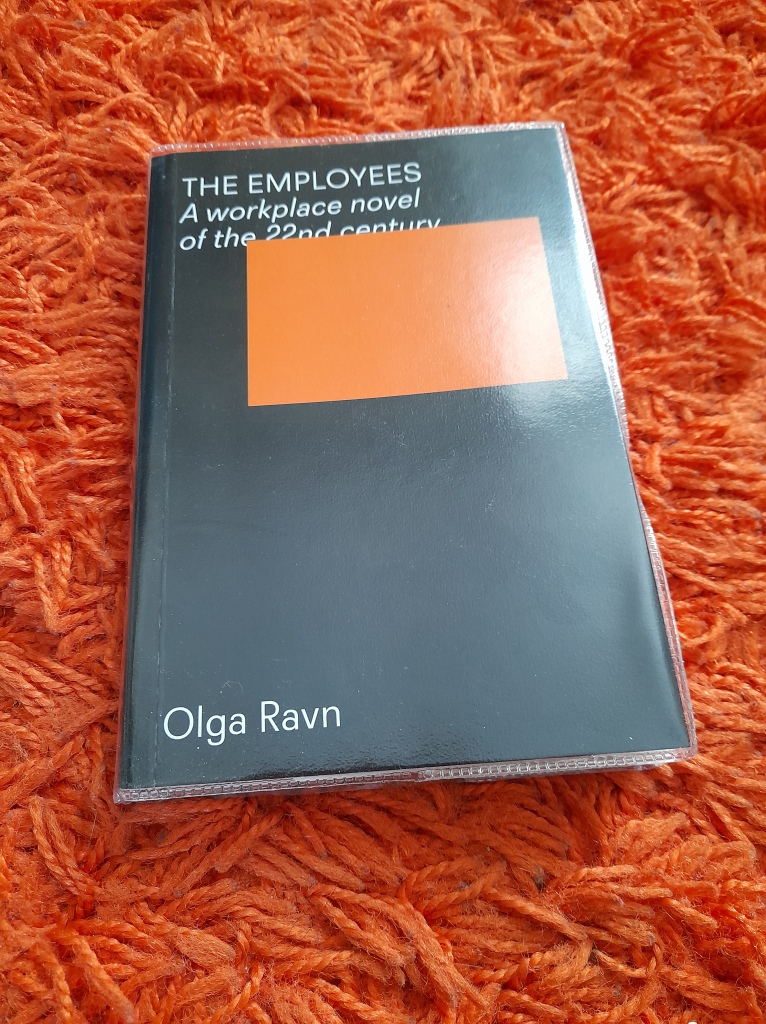
Olga Ravn: The Employees – A workplace novel of the 22nd century

DENMARK, EUROPE

Translated from the Danish by Martin Aitken

(book 1 of my #20booksofsummer21)

I just finished the first of my 20 books of summer (hosted annually by Cathy at 746 books). The Employees is a very short novel (135 pages in the English translation) by Olga Ravn, who is best known in her native Denmark for her poetry. Ravn’s oblique novel (published by Lolli Editions) has been shortlisted for the Booker International Prize (with the winner to be announced on 2 June). The book has been expertly translated by Martin Aitken, who also translates from Norwegian, notably having translated Hanne Ørstavik’s Love, which I reviewed in 2019.

The Employees is set aboard a space vessel (the Six-Thousand Ship) in the not-too-distant future, at some point during the 22nd century. In an experimental take on epistolary fiction, the book comprises a series of employee statements, which vary in length from a single line (“Statement 021: I know you say I’m not a prisoner here, but the objects have told me otherwise”) to a couple of pages.

We are initially thrown in media res, trying to piece together meaning from this jumbled bundle of bureaucratic documents, which appear out of sequence: the book opens with statement 004, which is followed by statement 012, and so on, initially giving the novel a jigsaw-like aspect. And that is before we even begin to consider the content of the statements, which feels equally confounding, as we attempt to shape the information that is being drip-fed to us into some kind of coherence.

A narrative does begin to emerge, however. The aim of the written statements, as laid out in an opening page replete with futuristic corporate jargon, is to evaluate the way employees relate to certain objects, and the rooms in which they are placed, “to gain knowledge of local workflows and to investigate possible impacts of the objects … illuminating their specific consequences for production.” Anyone who has worked for a big corporation will be aware of the semantic nihilism and euphemistic double-think of business-speak, which is particularly rampant during those ubiquitous annual appraisal and objective-setting exercises, or during periods of “change management”. Ravn identifies the particular form of existential horror thrown up by such workplace conventions.

From the start we know that the ship contains mysterious objects (“It’s not hard to clean them. The big one I think, sends out a kind of a hum”), and that some of the employees are more human than others (“He said ‘You’ve a lot to learn my boy’. An odd thing to say, seeing as how I was made a man from the start.”) The objects seem to be contained in just two rooms, and to to be alive, or at least faintly sentient. Meanwhile, some of the employees have been ‘modified’ in some way: as Statement 015 informs us, “I’m very happy with my add-on … I’ve had to change completely to assimilate this new part that you say is also me. Which is flesh and yet not flesh. When I woke up after the operation I felt scared, but that soon wore off”.

The book initially works as a statement about the automation of working practices, and the dehumanisation inherent to a long-hours culture and a focus on productivity over all else. “Statement 044: The first smell that disappeared was the smell of outside, of the weather, you could say. Of fresh air. … The last smell that disappeared was the smell of vanilla. That, and the fragrance of my child when I would bend over the pram to pick him up”.

The statements gradually and unevenly progress chronologically, over an 18-month period during which the testimony has been taken. There is a reference to the room with the objects as a “recreation room”, references to new dreams proliferate, along with smells, music, light, recovered memories of earth and unexpected emotions: “You tell me: This is not a human, but a co-worker. When I began to cry you said: You can’t cry, you’re not programmed to cry, it must be an error in the update.

As time goes on, signs of conflict between employees begin to emerge, and the novel becomes a meditation on what it means to be human, and what it takes for a life to have meaning. Ravn combines genre tropes and a deft knowledge of corporate cliché to concoct a new take on sci-fi, which combines the uncanny with a sometimes touching study of burgeoning humanity.

Interestingly, the book opens with a dedication to artist Lea Guldditte Hestelund “for her installations and sculptures, without which this book would not exist”. It is written, then, in response to this recently exhibited work, which has the “character of a physical science fiction story”.

Multi-layered, Monumental Work of Artist Meleko Mokgosi (Botswana)

SUB-SAHARAN AFRICA

Meleko Mokgosi is a an academic artist: his first UK exhibition, held in late 2020 at the Gagosian in London, came with a two-page book list of 43 different titles, primarily focused around post-colonial feminist discourse. He comes across as inherently serious, and is quoted by The Guardian as saying “I never romanticise being an artist. I don’t do the whisky and cigarette at 3am.” Note the singular.

The canvases are on an epic scale, at 8 ft x 8 ft, and Mokgosi identifies as a ‘history painter’ in the Western tradition of epic painting that dominated during the 17th to 19th centuries (paintings which took as their subject matter improving subjects such as Bible stories, Greek mythology or historical scenes of battle). I wish it had felt safe enough covidwise to visit the exhibition in the autumn, but I had still sworn off tubes, trains and buses at the time. I have a book of reproductions from the show that was curated by the Fowler Museum at UCLA in Los Angeles in 2018, but obviously their scale can’t compete!

In the monumental size of his canvases, Mokgosi is giving prominence to a subject matter that has been entirely overlooked by the Western tradition, of course. The everyday lives of black Africans are here, then, perhaps made heroic, and given a significance grounded in history and non-white traditions. Two canvases show texts, so faint as to be obscure, telling folklore tales that circulated in the oral tradition, in Setswana, the principal language spoken besides English. English is the national language of education in Botswana, although there are 28 language in use – most of which are barred for use in education or the media. As a result, particularly in rural areas, many children are taught in a completely different language to that taught at home.

At the Fowler the canvases were exhibited as a frieze along three walls, and some of the canvases bleed into each other. Mokgosi claims influences such as Lucian Freud and Max Beckmann, and there is also a touch of early David Hockney in some of his hyper-realistic portraits, I felt. He uses as source material photographs taken by himself on return trips from the USA to his native Botswana, or taken by an assistant based there, as well as pictures sourced elsewhere.

As he told Ocula magazine, in building up skin tones Mokgosi uses only four colours (raw umber, burnt umber, raw sienna and burnt sienna), using the beige of the canvas as the lightest point, and dispensing with white paint entirely when creating highlights on black skin. This means a highly accurate and painstaking placement of paint is required from the outset: as demonstrated in the portrait of the moneyed, glossy-limbed young woman above. I wish I knew what she held in her hand, as she sits with her thoughts.

Mokgosi’s painting combines hyper-realist, almost photographic representations with text and sometimes more impressionistic background elements.

Botswana is generally regarded as a country that has avoided the post-colonial excesses of some other sub-Saharan African nations, where corruption and instability can be rampant. There is universal primary education, and relative transparency in governance. But inequalities remain: contrast the state school children pictured above, engaged in outdoor work, with the formally posed private school children pictured below. There is strength, solidarity and self-sufficiency perhaps, though, in the interlinked arms of the girls above, with their backs turned away from the gaze of the American or UK viewer.

Other aspects of southern African culture are foregrounded: below we see pictured the rise of macho nationalism among young (surely, here, barely adult?) men, the aspirations of workers living in one-room accommodation (note the ornamental ceramic dog, a motif that reappears in other paintings by Mokgosi, and the neatly arranged cuttings featuring idealised – often white – images of consumption and complacency) and the enduring gender disparities (the woman seated on the floor, the man in the chair). All this makes for a fascinating, multi-layered sequence of work.

My Bowie Top 10 (UK)

There are rich pickings when it comes to choosing a musician from the UK to cover for the blog. You didn’t think I was going to miss out my home country, did you?

I’ve gone for the only one that I love to the extent of buying books about them – where my curiosity about the artist has been as all-encompassing as my enjoyment of the music. (Though I have at one point or another owned both a biography of Freddie Mercury and Debbie Harry’s excruciating autobiography – great photos though, she was so astoundingly gorgeous.) And I don’t just own one Bowie book, I have a whole heap, some of which are pictured here.

Bowie’s manipulation of his own image was fascinating, and has been over-discussed everywhere already. Even when he didn’t look classically good-looking (when, say, wearing a one-legged knitted romper, or while alarmingly thin in the mid-70s), his outfits, flare and magnetic stage presence meant that you couldn’t take your eyes off him.

Post-coke Bowie was all gloss and suntan, shades and a hint of athleticism, before coming perilously close to uncool in the 90s, then disappearing altogether for a decade after his heart attack. His two late albums, the last coinciding with his death from cancer, sealed his reputation as king of enduring cool, and as a risk-taker, a charmer and someone who was doggedly persistent in following up on his ambitions, influences and inspirations, whether dueting naffly with Lulu or touring incongruously with the Nine Inch Nails.

Here are my 10 favourite Bowie songs, in order of release:

  1. Five Years from The Rise and Fall of Ziggy Stardust and the Spiders from Mars (1972). This classic dystopian, and as the ‘Bowieologist’ David Buckley has pointed out, somewhat hysterical track never becomes boring.
  2. Time from Aladdin Sane (1973): “Time, he flexes like a whore, falls wanking to the floor” – a brilliant song, with a lyric that always make me snigger, and, as Chris Leary writes in his book Rebel, Rebel, suggests “a mime sequence blessedly never performed”. Lots of lovely Mike Garson piano.
  3. Lady Grinning Soul also from Aladdin Sane: A nape-tinglingly gorgeous, epic movie-soundtrack of a song (and not very typical of Bowie), with beautiful twiddly piano from Garson. Purportedly written about Bowie’s lover at the time, the enigmatic, reputedly transsexual model Amanda Lear, who was muse of Salvador Dali and appeared on a Roxy Music cover.
  4. Sweet Thing – Candidate – Sweet Thing from Diamond Dogs (1974): Amazing lyrics, and a bit of faux Lou Reed-style growling (“If you want it, boyz, get it here thing”) make this a winner for me. “We’ll buy some drugs and watch a band/And jump in a river holding hands” https://www.youtube.com/watch?v=vrfc8c6VkTA
  5. Win from Young Americans (1974): a breathy and haunting ballad, a lovely record: “someone like you should not be allowed to start any fires”.
  6. Sound and Vision from Low (1977): a brilliant track from Bowie’s slightly sulky post-coke Berlin exile years. “Blue, blue electric blue/That’s the colour of my room/Where I will live”.
  7. It’s No Game (Part 1) from Scary Monsters (1980): fabulously screamy track, featuring Japanese female singer Michi Hirota.
  8. Fashion from Scary Monsters (1980): the video is excellent, with its sneary dancing, and the ever-catchy “Fa-fa-fa-fa-fashion” lyric. The lyrics satirise the world of which Bowie was very much a part, “It’s loud and it’s tasteless and I’ve seen it before”.
  9. Where are we now? from The Next Day (2013): his best song for 33 years and an instant classic, laden with nostalgia and a poignant reflection on the passing of time: “As long as there’s sun/As long as there’s rain/As long as there’s fire/As long as there’s me/As long as there’s you”.
  10. Lazarus from Black Star (2016): valedictory, beautiful and self-referential memento mori from Bowie’s final Black Star album: “Look up here I’m in heaven”.

20 Books of Summer 2021

After weeks of arranging and rearranging piles, I’ve decided on the following books for my 20 books of summer, a project that runs throughout June, July and August, and is hosted by Cathy at 746books (a total of 6,432 pages, which means reading 70 pages a day on average, which I expected to be a bit tricky):

  1. Annabel Lyon, Consent: This is the second of my book club’s two recent choices (the first was Naoise Dolan’s Exciting Times). I put all the titles of the novels longlisted for the Women’s Prize into a hat and picked two at random – on video so there was evidence that I didn’t cheat and simply substitute my own favourites! Despite all this my first pick was resoundingly rejected (How the One-Armed Sister Sweeps the House by Cherie Jones, on the basis that it would be “depressing”). So we’re reading Consent, though it doesn’t exactly sound like a barrel of laughs either! FINISHED, review here.
  2. Anne Tyler, Dinner at the Homesick Restaurant: Liz has been rereading and reviewing Anne Tyler’s work in its entirety this year on her blog, and I meant to read this one in time to participate and didn’t, but I can at least read it over the summer. I can’t remember if I’ve read this particular Anne Tyler before – I did read most of her books in my 20s, and have carried on reading almost all her subsequent books as they have come out ever since then. FINISHED, review here.
  3. Annie Ernaux, Les Annees/The Years: I keep meaning to read books in French to preserve/revive my knowledge of the language, evidence of which was last seen in about 1998. I own the French language version of this book, which was shortlisted for the Booker International, and I’ve borrowed the English language version from the library for if (when) I get stuck. I got halfway through the Annie Ernaux book, which was clever but deathly dull, and swapped it for A Children’s Bible by US writer Lydia Millet, review here.
  4. Arundhati Roy, The God of Small Things: I started this book back when it won the Booker in the 90s, but didn’t give it much of a chance before giving up. My mum recently read it and recommended it, so I thought perhaps it was time to give it another go. Maybe I’m older and wiser now? FINISHED: Review here.
  5. Caryl Phillips, A View of the Empire at Sunset: A fictionalised account of the life of the author Jean Rhys, who I’m endlessly intrigued by.
  6. Christine Dwyer Hickey, The Narrow Land: Winner of the Walter Scott Prize for Historical Fiction last year, about the artist Edward Hopper.
  7. Daniel Kehlmann, Tyll: Short-listed for the Booker International last year, I like Kehlmann’s mordant humour, although this book is based on the character of a trickster from German medieval folklore, so I hope I don’t find it too bewilderingly obscure. Kehlmann’s style is typically very readable though, so I’m not too worried. FINISHED, review here.
  8. Deborah Levy, Real Estate: The third and final part of Levy’s work of “living autobiography”, which has just been released. I loved her erudite, emotionally intelligent and compulsive earlier instalments, which reference philosophy, gender politics and the nature of writing, interlaced with a wry sort of humour. FINISHED, review here.
  9. George Saunders, A Swim in a Pond in the Rain: My first non-fiction work from the Booker-winner, this is a book that accompanies the reader on a close reading of several classic Russian short stories, based on a class taught by Saunders at Syracuse University as part of the Creative Writing MFA that he heads up. Looking forward to this one, I love unnecessary homework (shame I didn’t love homework when it counted, I would have got better A levels).
  10. Junot Diaz, The Brief Wondrous Life of Oscar Wao: This book was everywhere about 10 years ago, and I can’t remember how long it has been languishing on my shelves for, unread. Time to read the damn book! Apparently Bowie was a fan, and that’s good enough for me. Read and my review is here.
  11. Maria Stepanova, In Memory of Memory: A Russian novel shortlisted for the Booker International and published by the always beautifully produced Fitzcarraldo Editions. Swapped for Visitation by Jenny Erpenbeck (Germany).
  12. Olga Ravn, The Employees – A Workplace Novel of the 22nd Century: Another book shortlisted for the Booker International this year, this short experimental sci-fi novel is structured as a number of witness statements put together by a workplace commission investigating an incident aboard a space ship. As far as I can tell! FINISHED, review here.
  13. Patricia Lockwood, Priestdaddy: Much-lauded and comedic memoir by the writer who has been dubbed the “poet Laureate” of Twitter. FINISHED, review here.
  14. Patrick DeWitt, Under Major Domo Minor: I loved The Sisters Brothers, and I have had this sitting around for a loooong time. I don’t know much about it but I’m hoping it retains the dark humour of the earlier novel.
  15. Rose Tremain, Islands of Mercy: My lovely friend Polly gave me this gorgeous hardback when we met for drinks in the freezing cold in April, and I’m determined not to let it malinger on my shelves as I have always enjoyed Rose Tremain’s work. Swapped for Kei Miller’s poetry collection The Cartographer Tries to Map a Way to Zion, review here.
  16. Steinunn Sigurdardottir, Yo-Yo: An award-winning book of betrayal and friendship by a prominent contemporary Icelandic writer. I picked this one up secondhand from the excellent Oxfam bookshop in Herne Hill and have been meaning to get round to it for ages. I started this one and hated it, so have swapped it for another Icelandic novel, Moonstone: The Boy Who Never Was by Sjón
  17. Svetlana Alexievich, Last Witnesses: Unchildlike Stories: I bought this book in February but haven’t been able to quite face it it, as it is basically reportage of Soviet children’s experiences of the Second World War. But Women in Translation month in August and committing to it here might be enough to give me a nudge. READ, review here.
  18. T. C. Boyle, Talk to Me: I’ve had a fascination with animal language studies since I studied linguistics at university, and later found documentaries such as Project Nim gripping. This book follows the travails of a professor of psychology and his sign language-using chimp. READ, review here.
  19. T. C. Boyle, The Terranauts: Another Boyle, following eight volunteers selected to take part in a televised ecological experiment, enclosed in a glass dome in the desert. The novel was inspired by real events in the early 90s. Swapped for Shadow of the Crescent Moon by Fatima Bhutto. READ, click link for review.
  20. Witold Szablowski, How to Feed a Dictator: Szablowski has tracked down the former chefs to Saddam Hussein, Idi Amin, Enver Hoxha, Fidel Castro and Pol Pot to reveal (I hope) some interesting insights.

TV series Wellington Paranormal (New Zealand): Review no 154

FAR EAST, SOUTH ASIA AND AUSTRALASIA

This month’s quick TV review comes from New Zealand. I’m always trying to find things to watch with my teenagers, as they are inclined to hole themselves away in their room or to sit in silence with headphones on, deep in their phones. So I was over-excited to learn that a spin-off of Taika Waititi’s 2014 vampire mockumentary feature What we do in the Shadows, recently adapted for TV in the UK (with great performances by Matt Berry and Natasia Demetriou), was about to be serialised on NOW TV.

Wellington Paranormal retains the mockumentary format, as hapless cops Minogue and O’Leary are filmed carrying out their roles as part of Wellington’s covert paranormal unit. The really quite small city of Wellington seems to be the most supernatural and spooktastic place in the world, as the police find themselves embroiled in cases involving aliens, werewolves and demonic possession, as well as straightforward hauntings. However, their increasing wealth of experience doesn’t seem to improve their ability to identify supernatural phenomena, and they are more likely to hand a parking ticket to a zombie than launch straight into chop-its-head-off mode. The deadpan acting is quite an achievement in itself, carried off with aplomb by the two leads, played by their namesakes Mike Minogue and Karen O’Leary, and there are plenty of laughs as a result.

Although created by Waititi and Jemaine Clement, Waititi was not directly involved in the writing and directing of the series, which was written by Clement, together with Paul Yates, Melanie Bracewell and Jessica Hansell, and directed by Clement, Jackie van Beek and Tim van Dammen. It’s silly rather than properly creepy, but might be scary for under-12s. The show, which currently runs to three seasons, is entertaining rather than outstanding – but I’ll take that.

Benjamín Labatut: When We Cease to Understand the World (Chile) – review no 153

Translated from Spanish by Adrian Nathan West

AMERICAS AND THE CARIBBEAN

I have an almost pathological aversion to physics. I grew up as the daughter of a scientist, so I can only assume that my utter lack of understanding of his pet subject came as something of a disappointment to him. I dropped the subject at 14.

Reading the rapturous endorsement from Philip “dust” Pullman on the back of the English translation of this 2020 book, then, initially gave me the heebie-jeebies:

We may be familiar with such things as Schrodinger’s cat and Heisenberg’s uncertainty principle … but the sheer audacity, the utter insanity of the ideas and thinkers who discovered these ideas has never, in my experience, been so vividly and terrifyingly conveyed as in this short, monstruous and brilliant book“.

I prevaricated, I dithered, I procrastinated wildly. I picked the book up, stroked the cover and put it back down. Days later I admired the yellow end papers, then flicked through the pages, Matrix-style like Keanu Reeves, trying to absorb the contents without actually having to engage with any of them: “I know Kung Fu!”.

Finally, I opened the book, cracking the spine nonchalantly, “quantum physics, huh? bring it on” and began to read. And I was captivated. Labatut alludes to the “recondite” knowledge of scientists, and this book is a treasure trove of such knowledge. I learned (kind of, don’t test me) the essentials of Shwarzchild’s Singularity, explaining the phenomenon of black holes, and potted biographies of great figures who’ve made jaw-dropping scientific discoveries, but this was not a dry, Wikipedia-type account. The prose, described by the author as “a work of fiction based on real events” is gripping, mixing erudition and deep research with beautiful composition, flights of imagination and bizarre historical facts.

I preferred the first half of the book, which weaves together disparate facts and fictions in a kaleidoscopic, sometimes apocalyptic whirl, to the second half, which concentrates on the rivalries between Erwin Schrödinger and Werner Heisenberg, although ironically this section is the one that is most obviously fictionalised rather than a lyrically written work of non-fiction.

At the crux of this book is “the heart of the heart” – something the mathematician Alexander Grothendieck conceived of as at the very centre of the discipline – and which seems to have driven him to insanity. Even at his most productive, Labatut writes:

For years he devoted the whole of his energy, twelve hours a day, seven days a week, to mathematics. He did not read newspapers, watch television or go to the cinema. He liked ugly women, squalid apartments, dilapidated rooms. He worked cloistered in a cold office with flaking paint falling from the walls, his back turned to the only window, with pen and paper on his desk and only four objects as decoration: his mother’s death mask, a small wire sculpture of a goat, a jar of Spanish olives and a charcoal portrait of his father, drawn in Le Vernet concentration camp.”

Despair and revelation seemed to come hand in hand all too often, as in case of Karl Schwarzchild, who calculated the point at which the theory of relativity collapses, conceiving a paradoxical point where a star exhausts its fuel source and begins to implode, a case in which “space-time would not simply bend; it would tear apart“. Thus, “time froze, space coiled around itself like a serpent. At the centre of that dying star, all mass became concentrated in a single point of infinite destiny.”

During the First World War, according to Labatut’s account, Schwarzchild began to fear that this same rent in the fabric of conceivable reality was being seen in the state of humanity: “He babbled about a black sun dawning over the horizon, capable of engulfing the whole world, and he lamented that there was nothing we could do about it. Because the singularity sent forth no warnings. The point of no return – the limit past which one fell prey to its unforgiving pull – had no sign or demarcation. Whoever crossed it was beyond hope. Their destiny was set, as all possible trajectories led irrevocably to the singularity. And if such was the nature of the threshold, Schwarzchild asked, his eyes shot through with blood, how would we know if we had already crossed it?

This stunning work about the wonders and pitfalls of genius, and the dangers and miracles of scientific discovery, woven through with the horrors of the wars of the 20th century, would be a deserving winner of the International Booker Prize, though some pedants may claim it to be barely a work of fiction. So far though, I’m finding the International Booker lists of the past couple of years far more inspiring than the “standard” Booker lists.

Mini catch-up: other books and films and stuff

I’m still wading my way through the International Booker shortlist, although I was slightly derailed by stress after spending a few nights in hospital with my daughter last week, and could only cope with Naiose Dolan’s Exciting Times, which I quite liked. It has an endorsement from David Nicholls on the cover, but doesn’t beat his One Day in my opinion: though that was very relatable to me, and covered my generation, whereas this made me feel a bit middle-aged. I mean, I am middle-aged, so fair enough. However, it was a good read for a hospital vigil of sorts, when I didn’t want a challenge or to be made sad. It was very funny and sharp, and a bit romantic, about a young Irish teacher adrift in Hong Kong, and also great for a linguistics nerd like myself as there are interesting asides about languages (did you know Irish has lots of different words for seaweed?). It’s brilliant on social media etiquette, and overall I would recommend.

Off the International Booker shortlist I just read The Dangers of Smoking in Bed from the imagination of Argentinian writer Mariana Enriquez and expertly translated by Megan McDowell, but I didn’t love it. It’s very dark, and not without black humour, modern gothic with a nod to Argentina’s murky past – all of which makes it sound great, but the quality of the stories was patchy I thought, and some of them I just wanted to … well, end. So, yeah, I’m afraid although I found some of it brilliant, some stories were frankly boring or a bit juvenile in their desperate desire to shock.

Film

During April we watched Palm Springs on Amazon Prime., and loved it, though its not for kids. I read somewhere it is like Groundhog Day crossed with Bridesmaids, which is about right…

Then the other day we watched The Mitchells vs The Machines over on Netflix, which very much is a family film, but is also good fun for grown-ups.

TV

On All4 we’ve just found Stath Sells Flats, which is set around a family of hapless Greek-British estate agents in north London, and is just a hoot. Lots of familiar faces, and it reminds me a bit of my five years in Haringey in my 20s. I’m going to be watching the new series of the very funny Motherland this week too, a parenting comedy that is basically a documentary, in my experience!

Oscar-nominated Romanian film Collective (Review no 152)

EUROPE

A documentary revealing large-scale fraud in the national health sector, leading to preventable deaths from infection, was the worst possible film to watch in the weeks preceding my daughter’s admission to hospital for a major leg operation last week (she’s home now and recovering). Collective (2019) was nominated for best international feature film and shortlisted in the category of best documentary film at this year’s Oscars, and when I saw that it was streaming on iplayer I thought I’d take a look, but it was more gruelling than anticipated.

Romania is pretty notorious for state corruption. Ministers and entire governments regularly fall as a result of sleaze probes and media allegations, and its politics make the oily BoJo look squeaky clean. In 2015 a nightclub fire killed 27 young people and injured many others. There was a national scandal, as the nightclub had been licensed, despite a lack of fire exits.

However, a new scandal was to engulf the country when almost 40 more young people, who had been injured in the fire, died in the subsequent weeks, often from theoretically avoidable cases of severe infection.

An investigation by, incongruously, the Romanian Sports Gazette revealed that hospital disinfectants had been diluted by producers, and were up to 10 times weaker than advertised. Dan Condrea, the head of the pharmaceuticals company Hexi Pharma, accused of complicity in the disinfectant scandal, died mysteriously in a car crash soon after the facts were made public. Was his death suicide? An accident? Murder?

We follow Vlad Voiculescu, the newly appointed, idealistic young health minister, who seeks to improve the nation’s health situation, noting that in Romania people with money typically prefer to travel to other nations for medical treatment due to its dire state. However, his work is impeded by entrenched corruption and a lack of adequate health infrastructure, as well as the apathy and effective disenfranchisement of the electorate. The movie itself cannot be dismissed as a piece of political propaganda and, with its focus on the dogged work of journalists determined to uncover the truth, is moving, shocking and at times even awe-inspiring – and would have made a worthy, if undoubtedly slightly leftfield choice for an Oscar jury.

At Night All Blood is Black by David Diop: Review no 151

SENEGAL/FRANCE

Translated from the French by Anna Moschovakis

I started reading my way through the Man Booker International shortlist, beginning with At Night All Blood is Black by Senegalese-French writer David Diop, first published in French in 2018 and published in English translation in 2020. I have noticed that my reviews always seem to focus on serious and upsetting topics, and I am trying to lighten up my blog posts a bit … but, yeah, this book is not going to do that.

Rather, it is a short, sharp shock of a novel, historical fiction that examines the experience of Alfa, a young Senegalese ‘Chocolat’ soldier fighting for the French during the First World War. The beautifully translated prose is incantatory and looping, as Alfa berates himself for the events that lead to the death of Mademba, his “more-than-brother”, killed by a soldier described only by the blue colour of his eyes. Alfa struggles with misplaced guilt, and hates himself for his cowardice in refusing to slit his friend’s throat as he lay dying, like a “sacrificial sheep”, instead powerlessly watching his life painfully ebb away over a period of many hours.

The novel is visceral, and the relentless, lucid prose builds up a repetitive rhythm, like the rounds of battle the narrative is set within and between. Alfa’s actions, as he seeks to avenge Mademba, are so brutal and sadistic that they unnerve his fellow soldiers, both white and black.

“…when I returned to our trench the way a mamba slithers back into into its nest after the hunt, they avoided me like the plague. The bad side of my crimes had won out over the good side. The Chocolat soldiers began to whisper that I was a soldier sorcerer, a demm, a devourer of souls, and the white Toubab soldiers were starting to believe them. God’s truth, each thing carries its opposite within. Up to the third hand, I was a war hero, beginning with the fourth I became a dangerous madman, a bloodthirsty savage. God’s truth, that’s how things go, that’s how the world is: each thing is double

Alfa is sent away from the front to recuperate, and although he does not speak French he seems to be connecting with medical staff, as he works through his memories in drawings: he revisits his past in Senegal, the loss of his mother, the love of his father, his first romance with a local girl. We hope for redemption, but this book is not about redemption.

I smile at people, they smile back. They can’t hear, when I smile at them, the thundering laughter resounding in my head. Which is lucky, because they’d take me for a lunatic otherwise. It’s the same with the severed hands.”

The prose is shocking and powerful, and the translation feels flawless. I really think this book is outstanding, and would be a worthy winner of the prize.

Wars of the Interior by Joseph Zárate (Peru): Review no 150

Translated from Spanish by Annie McDermott

AMERICAS AND THE CARIBBEAN

With this book, the celebrated Peruvian journalist Joseph Zárate has created a work of reportage on the environmental and human costs of the demands of globalisation. Published in Spanish in 2018 as Guerras del interior, an English translation has just been released by Granta. Wars of the Interior isn’t my usual fare, but it seemed to be more than topical, and I’ve not yet covered Peru at all in my sofa-bound tour of global culture.

The book is divided into three sections, focusing on three principal commodities: wood, gold and oil. And it is full of righteous anger at the injustices wrought against ordinary, often illiterate and thus essentially powerless people by the large logging and mining companies. These behemoths replicate against often indigenous, peasant people the same inhumane brutalities that were enacted by colonial rulers in the past.

Reading about the absolute lack of environmental concern shown by loggers, the corruption, and the amount of environmental damage caused by the production of everyday commodities made me feel I should stop buying completely. It certainly made me feel guilty for the amount of books I buy, and for the piles of proofs that I print out for work (I just can’t keep sufficient focus if I read them on screen).

“A map is an instrument of power”, and the apparently empty land (or “silences”) mapped by official cartographers based in the capital, Lima, can frequently obscure areas of rainforest or land attractive for mining where native communities have traditionally made their homes, which is then parcelled off piecemeal and sold off to massive corporations. Communities unused to official bureaucracy, unable to read and write, who have perhaps never travelled to a large town or city before or even traversed a paved road are ill-placed to take on these companies. Maps say different things, and the bureaucracy in Peru doesn’t acknowledge the way peasants have exchanged land for centuries, or recognise their documentation as legitimate. And troublemakers are at genuine risk of assassination. Criminal links are widespread in these industries. For example, according to the World Bank, 80% of wood exports from Peru have illegal origins.

Peru is the greatest exporter of gold in Latin America, and the sixth largest exporter worldwide. But gold is a rare metal:

“If we collected all the gold collected throughout history – 187,000 tonnes, the World Gold Council estimates – and melted it down, it would barely fill four Olympic swimming pools”.

The mining of gold is also intrinsically wasteful and toxic. “To end up with an ounce of gold – enough to make a wedding ring – you need to extract fifty tonnes of earth, or the contents of forty removal lorries,” writes Zárate. Later he tells us that “whole mountains disappear in weeks”, and that mining enough gold for a pair of fancy earrings “produces some twenty tonnes of waste, which includes chemicals and poisonous metals” – specifically cyanide, since a wash of cyanide and water is used to dissolve the rock that surrounds the precious metal.

The final section discusses the oil industry, and shares evidence that the corrupting forces of capitalism have resulted in the misuse of both environmental resources and people. Children are coerced to help clean up oil spills with promises of the money for electronics, while the chemicals used to “clean” the rivers are accused of simply causing oil residues to disperse to the bottom.

By tackling these important but easily overlooked issues through a work of reportage, the impact on communities and the natural world really hits home. Not an easy read, but no doubt an important one. Whether it will make any difference at a grass roots level remains to be seen.