March 2021 Round-up

I’ve read a few great books this month, after splurging on a handful of newly released hardbacks (well, the library’s shut so…. and never mind all the unread books around the house).

The most enjoyable read was Canadian author Emily St Mandel’s 2020 release The Glass Hotel. I’d loved Station Eleven a few years back, which was feat of enlightening dystopia, following as it did a group of itinerant Shakespearean actors through a world rebuilding itself after a devastating deadly flu pandemic (the “Georgia flu”).

The Glass Hotel is very different and, at the most basic level, considers the fall-out from a Richard Madoff-type Ponzi scheme. It is way more than that though. It’s a cleverly layered tale of our capacity for complacency, and for simultaneously knowing and not-knowing, and the haunting narrative gradually creates a dreamlike, faintly hallucinatory world. The book is backdropped by the surreal glass hotel of the title, glowing on a Canadian promontory and only reachable by boat, where a young woman, Vincent, works as a bartender. It’s a haunting and philosophical study of resilience and morality, and best of all is utterly immersive and a pleasure to read – I recommend this book.

Also recommended, though possibly triggering, is the newly published A Lie Someone Told You About Yourself by Peter Ho Davies. I gobble up books that touch on traumas that resonate with my own. I had treatment for PTSD after my youngest daughter’s birth and I still wince if anyone says the word “midwife” in my presence. I find it cathartic to understand that other people have shared similarly traumatic experiences.

Widely described as autofiction rather than memoir, previously Booker-longlisted Ho Davies’ book is a beautifully written account of life touched by tragedy, when he and his wife are compelled to abort a much-wanted baby that is strongly suspected (but not guaranteed) to be carrying a devastating genetic mutation. Wracked with guilt, but simultaneously convinced of the inevitability of the decision, the father in the book, a university professor and writer (just as Ho Davies is) struggles to come to terms with the decision they made and with their loss. A much-wanted baby boy, an only child, follows, but his development is delayed in subtle and distressing ways that involve a coming to terms with adjusted assumptions. This book is a little like a prose poem, and reminded me a little of the incredible Blue Sky July, an elegiac and moving account (I sobbed throughout that book when it came out in 2008) of a mother’s experience of raising a small child born with a brain injury.

Last but most definitely not least, I found the TV series The Terror, first shown in the USA in 2018 and currently showing on iplayer in the UK, ridiculously enjoyable. Based on a novel by Dan Cummins, it is an imagined account of the doomed Arctic expedition led by Captain John Franklin in the 1840s, when the HMS Terror and the HMS Erebus sought to traverse the last unnavigated section of the Northwest Passage. ]

The cast is outstanding, with Jared Harris (also from the excellent Chernobyl) as the compelling Captain Francis Crozier and Tobias Menzies as Commander James Fitzjames. Paul Ready (the hapless dad from Motherland – which as I see it is basically a documentary) plays Dr Harry Goodsir and the thrilling Adam Nagaitis plays Cornelius Hickey. It’s just the right side of silly, with an excellent baddy and some good stiff upper lip captaining going on, plus some overblown supernatural horror stuff dropped in to zhuzh things up should they start to get too introspective. By the end I was on the edge of my seat, and I’m bereft now it’s finished. I haven’t been so entertained for ages. Or at least not since The Great finished.

Review no 145: The Global Dominance of Swedish pop

EUROPE

Earlier this month I happened on a few reviews for pop singer Zara Larsson’s new album Poster Girl, and got to thinking how Swedish singers seem particularly adept at giving us a catchy tune. I’m not mad on Larsson;s music myself, but she is wildly popular in the UK and in Sweden. Larsson’s last (2017) release, her second album So Good, reached number one in Sweden and was a top 10 hit in Australia, Denmark, Finland, Netherlands, New Zealand, Norway and the UK. Poster Girl, which to my ears is basically more of the same successful formula of unchallenging, escapist, proficient pop, has reached no 3 in the Swedish charts, no 11 in Norway, no 12 in the UK and no 170 in the USA, where I assume she is little known.

All the successful Swedish singers that I can think of are working very much in the genre of pop. Naturally, ABBA (named for the first initials of the four band members, Agnetha, Björn, Benny and Anni-Frid) spring immediately to mind. I wouldn’t call myself a massive ABBA fan, but having said that I was more than happy to sit through jukebox movie Mamma Mia, and even paid a trip to the cinema for Mamma Mia III. And if an ABBA song comes on the radio I’ll have a bit of an involuntary singsong, as if I’ve been subliminally conditioned to do so, which I suppose I have been. Oh yeah, and I did go to see Mamma Mia! – The Musical in the West End a few years ago but that was honestly only because a friend of ours was in the cast…

Pop songstress Robyn exploded onto the Swedish music scene in 1995, releasing her first album in her teens. She became increasingly successful and latterly (and arguably equally impressively) even credible. I genuinely like Robyn’s music, and listen to it for fun, which I couldn’t necessarily say for Zara Larsson – perhaps it’s a generation thing. In 2018 Robyn made a sensational comeback after almost a decade away, with her brilliant album Honey, which is an excellent example of smooth, intelligent pop music.

Coincidentally, I heard a programme on the radio this week that told me something I really didn’t know: Swedish songwriters are behind some of the biggest hits of the last couple of decades, and Swedish producers haven’t just been behind homegrown talent like Ace of Base, Avicii, Swedish House Mafia and Roxette. They have also produced career-defining hits for massive, global superstars like Britney Spears, Katy Perry and Backstreet Boys. Indeed, Sweden is the biggest exporter of pop hits per head of any country worldwide. The Swedish music industry has somehow employed the same methodical, technical brilliance pioneered by top Swedish-grown companies like IKEA to give pop music everywhere a Scandi-inspired sound.

Review no 144: Supa Modo – a movie from Kenya

SUB-SAHARAN AFRICA

In Swahili with English subtitles

TRIGGER WARNING: This film has a plot that focuses on the life of a terminally ill child

Supa Modo (2018) is an emotionally involving drama directed and co-written by Likarion Wainaina, which follows a family’s efforts to care for terminally ill nine-year-old girl Jo in the best way possible.

Jo has been staying in hospital full-time for treatment, seeing her mother and older sister only at weekends, although the days there are made more cheerful (albeit bitter-sweet) through friendships with other sick children and, in particular, superhero movies, which are shown along with live commentary by local film buff Mike.

When Jo’s mother realises that her condition in incurable, she makes the decision to take her back home to her rural village and look after her there. The whole village is touched by Jo’s plight, and her sister Mwix dreams of fulfilling Jo’s dreams of living the life of a superhero.

I liked the way Jo’s “tomboyish” interests in action films and football are presented as part of her, and refreshingly never challenged or treated as odd by those around her. With its focus on the love and support that a close-knit community can offer, the film reminded me of the old adage “it takes a village to raise a child” (which appropriately originated in Africa, a Google search tells me). However, although charming and moving in parts, for me it did tip over into mawkishness at times.

The film was a naturalistic study in love and resilience, but although described as a family film, I would hesitate to show young children such a potentially upsetting movie, especially if you don’t fancy answering a bunch of impossible questions afterwards. And if you’re looking for an escape from the grit and sadness of life, say, during a massive, seemingly never-ending pandemic, then I really can’t recommend watching this film, though I imagine it could be cathartic for some.

Supa Modo won the Film Africa 2018 Audience Award and is dedicated it “to everyone who has suffered loss”.

Review no 143: The Hairdresser of Harare by Tendai Huchu (Zimbabwe)

SUB-SAHARAN AFRICA

Set in modern Zimbabwe, The Hairdresser of Harare was a book club pick by my friend Dr Emily, a hotshot scientist, who has an unexpected tendency to search out and champion obscure African novels. Author Tendai Huchu was born and raised in Zimbabwe, but now lives in Edinburgh where it turns out, a little incongruously, he is now a qualified podiatrist.

The novel was published by Ohio University Press in 2010 as part of their Modern African Writing list, which aims to bring the best in contemporary African writing to international attention. The Hairdresser of Harare is written from the first person perspective of twenty-something Vimbai. Queen Bee at the Khumalo Hair and Beauty Treatment Salon, Vimbai is distrustful and quickly resentful when a disarmingly confident guy turns up hoping to fill a vacancy. Dumisami is good-looking, charming and adept at coming up with the perfect restyle for every woman and every type of hair, and threatens Vimbai’s status at the salon.

“Trust me, sister. This is your chance to help me” the man said, his voice as soft as running water. … “You have a round face, so instead of these curls we need to layer it so that it flows with the smooth contours of your face.” He worked briskly with his comb, then took a pair of scissors to trim the ends.

My heart was pounding. It had taken me an hour and a half to do that style and he dared to say that I’d got it wrong. The customer is always king. I’d done the style she asked for.

Five minutes later he was finished. He put his hands on Matilda’s shoulders and made her look in the mirror. …

“Sweet Jesus, I look like Naomi Campbell.” Matilda’s body was trembling with excitement.

Despite her resentment that she is at risk of being usurped by Dumi, Vimbai is in need of a lodger and she finds herself softening towards him when he happily moves in, making himself helpful around the house and teaching her young daughter Chiwoniso to read.

Nevertheless, after accompanying Vimbai to a local church service, complete with voluble pontificating priest, Dumi’s usually upbeat mood becomes distinctly darker and Vimbai is mystified as to why. It becomes clear that there is more to Dumi’s surface shine than meets the eye.

This novel is a deceptively easy, often comic read, which nevertheless adroitly covers some important contemporary issues. The social commentary is dropped in with a light touch, including mention of the head-spinning rates of inflation that render handfuls of cash almost worthless in an instant, the continuing threat of AIDS, casual corruption, the widespread poverty and the pressure of school fees (most parents have to pay fees of some sort for their children’s education in Zimbabwe). Added into the mix is homophobia: gay sex is considered to be a criminal act in Zimbabwe, but as the narrative progresses Vimbai is forced to confront some of her ingrained prejudices.

Review no 142: The Young Offenders (Irish TV comedy series)

Based on a film from 2016, this 2018-20 Irish coming-of-age comedy series is ostensibly unappealing. The main characters are feckless teens Conor (Alex Murphy) and Jock (Chris Walley), who spend their days engaged in acts of petty crime and trying to get off with the headmaster’s daughters (“shifting”). Conor and Jock are low in intelligence, inventively sweary and a constant source of mild disappointment to Conor’s mum, Mairéad (Hilary Rose). Mairéad is a sympathetic character who works on the local fish stall and struggles to manage the bills single-handedly, while trying to retain some semblance of control over her errant son and juggle a nascent romance with the slightly inept but amiable local policeman Sergeant Tony Healey (Dominic McHale), who is unable to drive and has to give chase to criminals on a push bike.

Despite, or perhaps because of, their absent dress sense and terrible haircuts, there is something endearing about the impressionable Conor and ringleader Jock. Underneath their laddish banter and bluster, terrible plans and frequent run-ins with Sergeant Healy they are openly affectionate to Mairéad, and mostly misguided but essentially well-meaning boys. And their frequent farcical scrapes are very funny.

My 14-year-old and I love the show, as the filthy language and illegal elements make it feel appealingly edgy without being amoral, and because her 12-year-old brother isn’t allowed to watch it (she insists on sub-titles as she can’t penetrate the strong Cork accents though!). We watched the first season, written and directed by Peter Foott, over a succession of Saturday nights during lockdown, and we’re looking forward to seasons 2 and 3 – and apparently there’s also a Christmas special starring eye candy Robert Sheehan (who I know best for his role as Nathan from Misfits). I liked Derry Girls and The Inbetweeners, but, for our family at least, this series has wider appeal.

Review no 141: A Golden Age by Tahmima Anam (Bangladesh)

FAR EAST, SOUTH ASIA AND AUSTRALASIA

First published in 2007, Tahmima Anam’s intimate civil war tale A Golden Age won the Commonwealth Writers’ Prize for the Best First Book and was shortlisted for the Costa First Novel Award. The edition I read was published in 2012 as part of the Canongate ‘the Canons‘ list, which is a slightly strange mixture of ‘boundary-breaking’ books that Canongate decided either were already classics in their own right, or deserved to be. I’m not convinced the collection has aged that well, but it’s an audacious idea.

Anam was born in Dhaka, Bangladesh (and now lives in the UK). This, her debut novel, is set in 1971 in East Pakistan, where Rehana Haque, a young widow, is throwing a party. Anam is great on description of food, Rehana is an excellent cook and the feast is described in loving detail. But civil conflict is brewing, a conflict that will lead to Bangladeshi independence, but will also lead to terrible violence and countless individual tragedies.

The civil conflict is the backdrop to the story of Rehana as she tries to do the best for her family, and to keep her children safe, while acknowledging that her freedom fighter son Sohail and idealistic daughter Maya, young adults now, are determined to live by their own principles, no matter what the cost. It also inevitably explores the regrets, disillusionment and compromises of middle age.

This emotive book covers a wide canvas, from Dhaka to Lahore to Calcutta. It provides an account of the heart-breaking decisions that families may be forced to make in wartime, about sacrifice and the toll of conflict and the particular cruelties of civil war. It also effectively illustrates the strength of maternal love, and the lengths a woman will go to to protect her children.

Rehana felt like a fully fleshed-out, flawed and multi-faceted character, as she trod her precarious path though life, but Rehana’s friends could seem more emblematic, while the guerrilla soldier who becomes important to Rehana felt positively wraithlike.

I enjoyed the book overall, but I found it reminded me of lots of other books. I don’t think I’ve read a book set in Bangladesh before, but I have read a lot of books focusing on the human cost of conflict, and this one covered some familiar territory, while feeling a bit episodic at times. It is undeniably an important story, sensitively told, which filled me in on a time and place that I was distinctly hazy about. However, the writing, although more than proficient, and often very beautiful, wasn’t transporting enough to raise this book above a 3 star read for me. The Good Muslim, a sequel to A Golden Age, was shortlisted for the Man Asian Literary Prize in 2011.

Review no 140: The enormity of the everyday – the art of sculptor Ron Mueck (Australia)

FAR EAST, SOUTH ASIA AND AUSTRALASIA

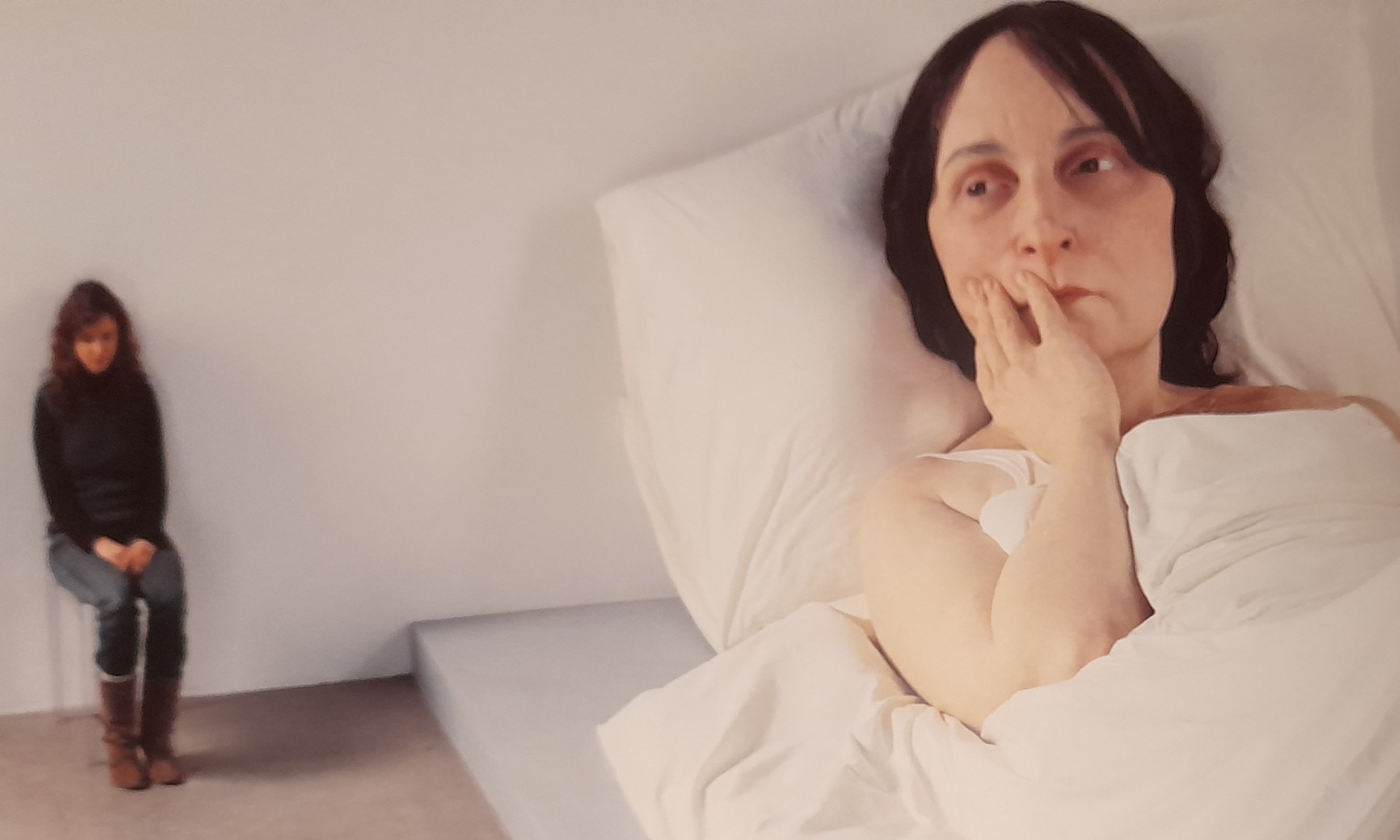
Work by Australian artist Ron Mueck is instantly recognisable. He creates hyper-realistic sculptures of normal-looking people, which disrupt our expectations of scale: sometimes his figures are immense, at other times they are much smaller than life-size. He renders the details of the bodies, their expressions and their wrinkled flesh with unsparing exactitude. As with Jenny Saville’s “brutal bodies”, her paintings of defiantly fleshy naked women, or Lucian Freud’s unflinching portraits, they are not necessarily beautiful, but they are fascinating. Mueck’s figures represent the full circle of life, from babyhood to old age. They often appear melancholic, gazing into the middle distance in exhaustion or self-absorption.

His sculptures appear to have been cast from life, but instead former puppeteer Mueck has typically created small clay maquettes, and used them to decide the composition of his work. A second, full-size clay model has then served as a mould for his final figure, cast in fibreglass. His craftmanship is conspicuously superior, and the British critic John Carey feels that Mueck exquisitely “bridges the gap between the avant garde and popular culture”.

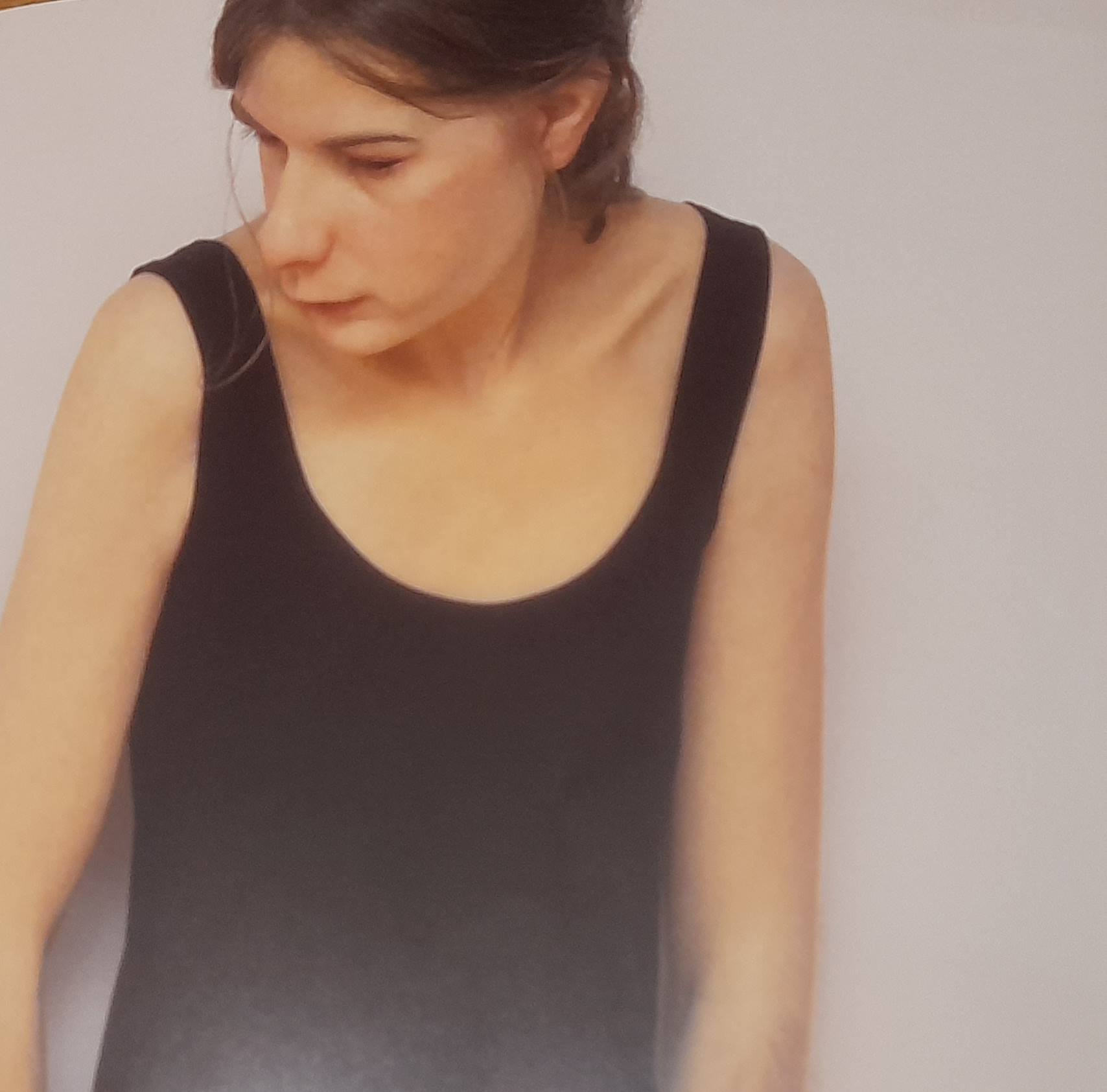
Ghost (1998) is a larger-than-life sculpture of a barely adolescent girl. She is wearing a swimsuit and looking away from the viewer, with an expression that encapsulates all the agonising self-consciousness that comes with being a teenage girl. Each one of the dense hairs on her arms has been painstakingly modelled: is she anorexic?

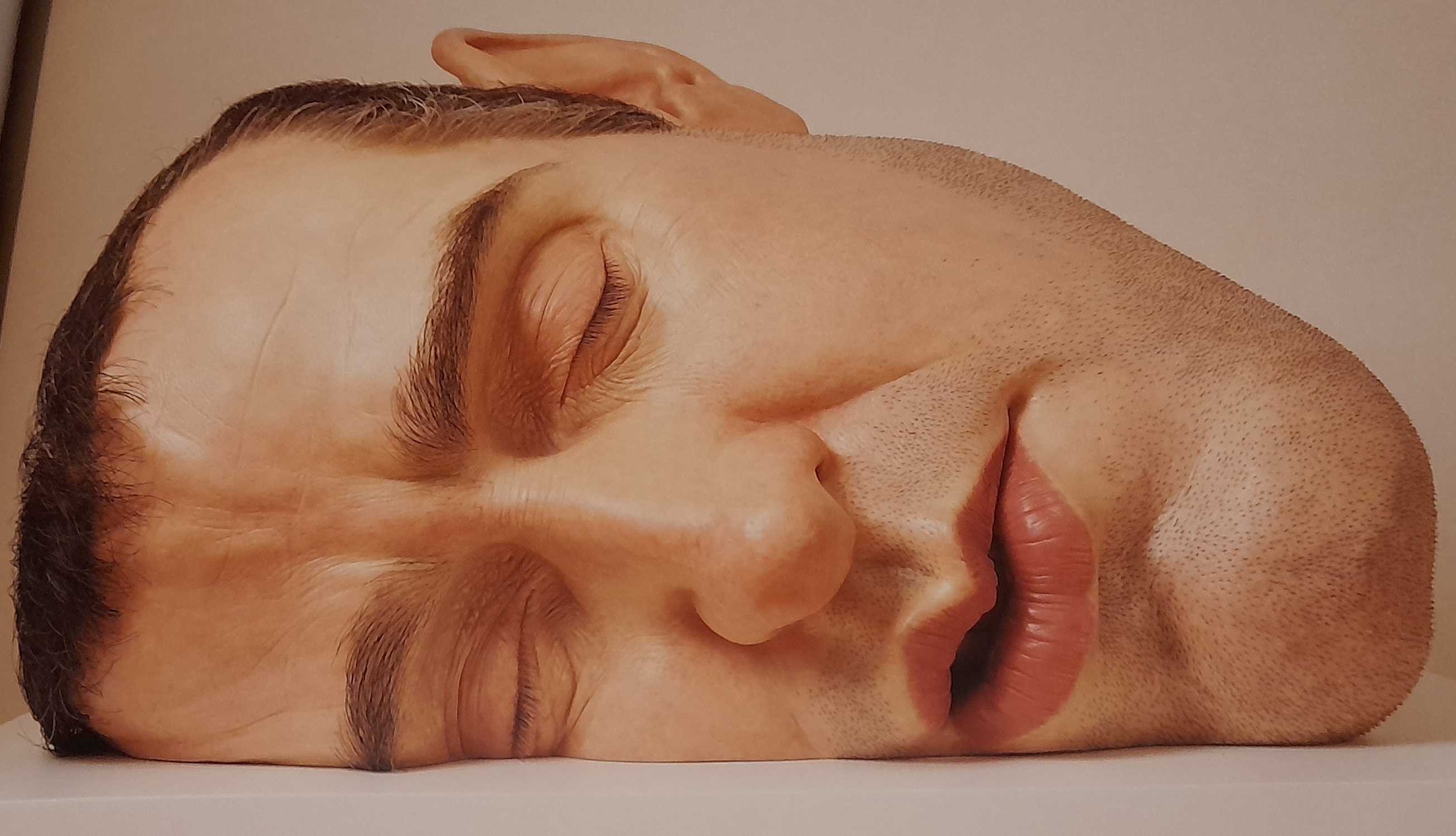
Mask II (2001-02) shows a huge disembodied male head (apparently based on the artist’s own features), which inevitably brings to mind decapitation, with the eyes closed, whether in death or repose.

Other works feature more than one figure. Spooning Couple (2005) represents two figures, lying as if in bed. She wears only a pair of greying knickers, while he’s wearing just a white T-shirt. While their lack of clothes and proximity to each other ought to express intimacy, their open-eyed expressions are miserable and introspective rather than sleepy or saucy.

A Girl (2006) is an monumental, five-metre long sculpture of a newborn baby girl. There’s something affecting about this acknowledgement of the enormity of the arrival of new life. You can see a video of it being made here:

More recently Mueck has created an overwhelming work representing 100 individual, large-scale human skulls – a memento mori and then some. In reproduction, the scale of his work is at its most startling when the image includes a real human observer.

Some work is light-hearted and tender though, and there’s some good examples of his more recent pieces in the video below (though I’m not super keen on the presenter guy). And I love Mueck’s enormous, hallucinatory, Alice in Wonderland-like Boy, created in 1999.

I find Mueck’s work compelling, but my view is not universally shared: he’s a bit of a ‘Marmite’ artist. For me, he’s about much more than technical wizardry: there is an immense humanity in his work, which can feel almost devotional, as if he’s identifying core truths about what it is to be alive: he renders the ordinary extraordinary.

This Guardian journalist thinks he’s crap, however, and claims to have felt physically nauseated at “the prospect of having to waste time, and words, on this flimsy gimcrack charade, on having to walk around with a straight face and pretend this is an exhibition. Of art.” What an unnecessarily angry man!

February 2021 Round-up

It’s been a stressful month. During the cold spell my husband set out for the post office and didn’t make it home for six days! A slip on the ice landed him with a broken arm, underneath an existing metal plate put in four years ago. A kindly passer-by drove him to hospital and he wasn’t allowed home until he’d had surgery, which didn’t happen for another five days. The break was complicated and the op took eight hours, but he’s been home for two weeks and is much less battered, though still unable to do very much at all.

Then, our family of five has been taking part in the Office for National Statistics survey, which is monitoring coronavirus prevalence in the UK, and which involves monthly COVID tests. Incredibly, the ONS lost the test taken by my 16-year-old in early December, finding it only this week, when they very usefully let us know that she had tested positive for COVID (asymptomatic) … nearly three months ago. Checking back, my 13-year-old did have the most awful, constant cough that week, which caused her to miss a full week of school despite testing negative for COVID. I can only assume that she did have COVID, but perhaps swabbed ineffectively. Assuming the positive test was not somehow a false positive, we seem to have got off relatively lightly, but it has knocked my confidence in both the swab tests and the ONS study.

Due to my husband’s accident all the cooking and cleaning and child-wrangling has fallen to me, and combined with work being busy and the home schooling fiasco going on in my house, I’ve not read much this month. I completed six books, only one of which I’ve read for the blog (The Bone Readers by Jacob Ross).

The books I enjoyed most were, in second place, Edith’s Diary by Patricia Highsmith, a domestic psychodrama bought secondhand, which had been lurking on my shelves gathering dust for yonks. I finally read it in honour of Highsmith’s centenary. In first place was Susanna Clarke’s Piranesi, which I bought for my mum for Christmas, and which she then kindly posted out to me so that I could read it too! It’s wonderful: fantastical and philosophical and sometimes blackly funny, and so haunting that it has stayed in my mind ever since.

My other reads were works of non-fiction: Zadie Smith’s new lockdown essay collection; a fascinating little book on Henry VIII written by John Guy as part of the Penguin Monarchs series and bought for my history-studying sixth former; and a book of art criticism by the absurdly talented late art critic and journalist Tom Lubbock.

I’m currently reading Joan Didion’s 1968 essay collection Slouching towards Bethlehem and Tahmima Anem’s Bangladesh-set novel The Golden Age.

Elsewhere I’m still enjoying The Great on TV, it’s the funniest thing I’ve seen in ages. Huzzah. For some reason I’ve been listening to (and enjoying) a bit of Jethro Tull while working, and when my rare downtime coincides with an empty living room I’m watching the new Adam Curtis series on iplayer. Is he a pseudo-intellectual or is he saying something profound? The jury’s out for now. I love the archival visuals combined with a mesmeric soundscape, plus a bit of Oxbridge rambling over the top. It hardly matters what his argument is and whether it hangs together! Bring it on Adam.

Are there any books that you would especially recommend this month?

Review no 139: On a le temps pour nous (Time is on our Side): a documentary film from Burkina Faso

SUB-SAHARAN AFRICA

In French with English subtitles (2019, running time 1 hr 7m)

In October 2014 riots broke out in the West African country Burkina Faso, one of the world’s poorest. Demonstrators attacked government and parliamentary buildings, the presidential palace and the state television headquarters in the capital, Ouagadougou. Some 30 people were killed, according to local reports. On 31 October President Blaise Compaoré, whose dictatorial regime had lasted 27 years, announced his departure from office. He subsequently fled to Côte d’Ivoire, and democratic elections were eventually able to take place.

This intimate documentary, On a le temps pour nous (Time is on our side), written and directed by Katy Lena Ndiaye, is filmed several years after the hope, anger and idealism of the 2014 uprising have faded. Interspersed with footage of key scenes from the dramatic events of 2014, we follow the life of rapper and political activist Serge Bambara (aka Smockey – I’ve had to bite back an urge to anglicise it to Smokey), co-founder of the ‘Balai Citoyen’ (Civic Broom) movement.

Bambara was thus one of the principal architects of the popular movement that brought about the change of regime, fuelling rebellion among a generation of young people. Burkina Faso is a young country anyway, with only 7% of the population being over the age of 55.

Bambara’s political message echoes the ideology of the country’s former socialist revolutionary leader Thomas Sankara, whose death, orchestrated by a Compaoré-led coup in 1987, ushered in decades of repressive dictatorship.

Although the documentary is intensely, even intimidatingly, alpha male-orientated, Ndiaye evidently succeeded in gaining Smockey’s trust and respect in order to embed herself within his social environment. In contrast, Ndiaye’s most well-known work is the 2007 documentary film En attendant les hommes (Waiting for Men), which focuses on female muralists in Mauritania. What remains the same in both, it seems, is Ndiaye’s talent for drawing out the inner motivations of her subjects.

It was easy to see why people would get behind Smockey, who embodies a heady mix of a magnetic stage presence, an emphatic rap message, banging rhythms and absolute political conviction. I suppose its a demonstration of the unwavering self-belief and inspirational rhetoric that powers support for populist politicians throughout the world. I’ve a doe-eyed, often misguided, weakness for charisma, but that notwithstanding I’d certainly much rather have listened to Smockey rapping than the noxious Trump pontificating at one of his rallies.

Although Compaoré has been toppled, the country is still riven by political division, together with the rising impact of political Islam. While Smockey acknowledges that he is not hugely in favour of the new Government, he also accepts that it was elected by the people, for the people, and as a result it is not his place to seek to unseat it.

Smockey is an educated man, who was brought up in a privileged milieu, the son of a former minister and ECOWAS (Economic Community of West African States) official. His mother was French, and Bambara was able to attend university in Paris. The contrast with the typical life of a Burkinabé (citizen of Burkina Faso) is stark. The country’s first higher education institution was built in 1974, and the overall literacy rate is less than 50%.

We learn, too, during an emotionally unguarded moment, that Bambara’s father was permanently changed by spending two years under house arrest on what sound to have been trumped-up charges: “it broke him … and it broke his family … oui.”

Bambara quotes the Martinique-born political philosopher Frantz Fanon:

Man on earth is nothing if he’s not slave to a cause, that of the people, that of justice, that of freedom

These sound like words Bambara might have composed himself, as his own rhetoric is so electrifying. In one late scene he reaches out to people, effectively saying migration is not the answer the country’s woes, and that if people are brave enough to leave Burkina Faso, they are brave enough to stay.

If you have the capacity to bear all of this suffering, to get to the other side, to cross the Mediterranean, you can stay and fight with us here … Happiness is not Las Vegas, it’s not Paris, it’s not Hong Kong or any of those places we see on TV. Paradise is here in Burkina Faso.

The film closes with the lyrics of Senegalese rapper Didier Awadi, who Smockey joins on stage, as he pelts out his song “Ils ont l’argent mais on a le temp” (“they have the money but we have the time“). If there was ever a song that screams at someone like myself to check my privilege, this must be it, as Awadi raps “they have the watches, but we have the time“.

I have a personal and professional fascination with the power of political rhetoric to rouse a populace, and this is a documentary that is never less than compelling, sometimes thrillingly so.

Review no 138: The Bone Readers by Jacob Ross (Grenada)

AMERICAS AND THE CARIBBEAN

Winner of the Jhalak Prize for the best book written by a UK-based author of colour, Jacob Ross’s crime novel The Bone Readers has received ecstatic praise from readers and reviewers, including Booker Prize-winning author Bernardine Evaristo. Ross was born in Grenada, and set this, his first crime novel and part of a planned trilogy, on the Caribbean island of Camaho (an alternative name for Grenada).

I’m not big on crime fiction, but our book club chose this book for one of our recent reads. It provided me with useful blog-fodder (given I’m trying to cover reads – as well as art, music, film and TV – from every country for which it is available). I know my fellow book clubbers and plenty of other people can’t get enough of crime fiction. Apparently people find the genre cosy, which makes my mind boggle….

The book follows the exploits of Michael “Digger” Digson, who is recruited unwillingly by alcoholic police chief DS Chilman into a team of semi-official, plain clothes homicide investigators after he miraculously identifies those responsible for a boy’s murder in a hastily assembled police line-up.

Digger is haunted by the death of his mother, killed by police during his childhood, apparently with the assent, if not the outright complicity, of his high-ranking police boss father. What Digger lacks in experience he makes up for in unlikely innate forensics skills – the typical renegade cop cliché, transposed to a beautiful Caribbean island, where gorgeous women seem to fall at Digger’s feet.

He receives some training abroad, then returns to the squad in the Caribbean. The mysterious Miss Stanslaus is soon recruited to the force, and she and Digger get swept up in well-concealed crimes and shocking secrets. I found the Caribbean patois a bit tricky to penetrate at times, but mainly I just don’t enjoy genre fiction and I especially don’t enjoy crime fiction, however great it is reputed to be.