Book Review: The Seven Moons of Maali Almeida by Shehan Karunatilaka (Sri Lanka)

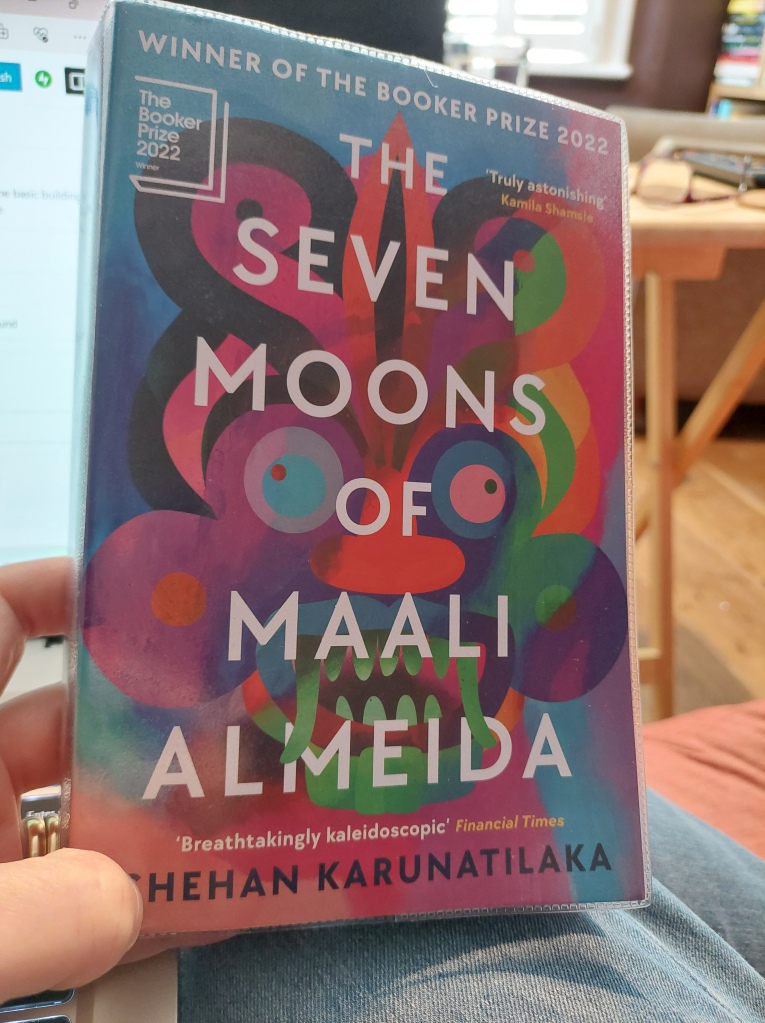
The Seven Moons of Maali Almeida won the Booker Prize in 2022 and is a fantastically imaginative, often darkly humorous, beautifully written feat of politically-minded speculative fiction.

The book is set in the Sri Lankan capital Colombo in 1990, during the civil conflict. This is a world of violence, corruption and disappearances. Though the protagonist, Maali, is no longer part of it: he’s in the afterlife, a mash-up of petty inefficient bureaucracy and horror movie.

In life, Maali (“Photographer. Gambler. Slut.”) was a 35-year-old war photographer, a compulsive gambler, and a gay man with a proclivity for beautiful young guys. Until he was brutally murdered and dismembered. He can’t remember the circumstances of his death, and he’s told by the powers that be in the celestial waiting room that he has seven moons (ie days) in which to figure out who killed him, and why, and to make sure that his controversial secret stash of photos ends up in the right hands. This is definitely the first detective novel I’ve read where the deceased person is the investigator.

The character of Maali is very loosely inspired by the real case of a murdered journalist and closeted gay man, Richard de Zoysa. Maali has left behind a boyfriend, DD (loved but extensively cheated on), and a good female friend, Jaki, both of whom are also determined to find out what happened to him. Seven Moons also comes with a large extended cast of the living and non-living: corrupt politicians, errant family members, spooks and demons. Karunatilaka has a vivid turn of phrase: one character is described as having “a smile that molested a thousand interns“.

In places the book is extremely violent, and brutal in its descriptions of (sometimes real-life) atrocities. It is lightened by humour, which rather than feeling inappropriate instead made it possible for me to traverse the book without being overwhelmed by the horror. It would definitely be best avoided by some readers though.

On the cover of the paperback, The Times describes the book as a combo of Stranger Things and Salman Rushdie. This does the book a disservice: it’s more high culture than Stranger Things and I found it less arrogant and more readable than Salman Rushdie’s fiction (though I was gripped by his new memoir Knife). If I have a criticism it is that Seven Moons is perhaps a tad overlong, at just over 400 pages. I felt that the action sagged in the last one-third of the novel – although the ending was worth the wait.

Book Review: Sidesplitter: How To Be From Two Worlds at Once by Phil Wang (Malaysia)

I have an Audible subscription and often struggle to choose my monthly book as I find so many narrators really irritating (mea culpa). Having enjoyed this audio book, written and narrated by British/Malaysian comic Phil Wang, I’m thinking work by comedians might be the way to go.

The book ticked a few boxes for me in terms of subject matter. Wang has a British mother and Chinese-Malaysian father, and although born in the UK he moved to Malaysia within weeks of his birth and was brought up and educated in Sabah, Borneo, only moving to the UK in his late teens.

I love a culture-shock story, and I’m hugely interested in the stories of those who are multi-lingual or who have been compelled to adapt to a new society, whether willingly as a traveller or student (eg Fifty Sounds by Polly Barton), or through less fortunate circumstances, perhaps as a refugee (eg the classic kids book When Hitler Stole Pink Rabbit by Judith Kerr).

Wang pokes fun at the idiosyncracies of both British and Malaysian culture. Malaysian cuisine sounds amazing (except the deserts), and made we want to seek out a restaurant pronto. British food is always an easy target (although has improved immeasurably), but he makes some funny observations about the national aversion to flavour – unless it’s English mustard or Marmite – and the strange way that, considering the UK is an island nation, so many people are squeamish about eating fish.

One chapter covers language. Wang speaks English, Malay (“relatively easy to learn and mercifully hard to forget”) and (some) Mandarin (easy to forget, as if it was an “extremely long password” or “designed specifically to punish those who would dare to leave China and curse them with muteness if they ever returned”). He gives a hilarious account of attempting to film in China with a more-limited-than-remembered vocabulary. Most Malaysians know both Malay and English, and many know more, and being multi-lingual is very much the norm. In the UK, of course, some people seem to almost take pride in not knowing another language: where’s the motivation?

This book covers some serious topics and is informative amid the humour. Wang discusses the inconsistencies of colonialism, Malaysia’s route to independence, the difficulties of having a dual identity, the irrationalities of cancel culture (“culture is appropriation”) and his experiences of casual racism in the UK.

But the book also made me laugh out loud at frequent intervals, while Phil Wang’s delivery lifted the content, and I suspect made it more immediately engaging than it would be on paper.

Book review: Great British Chefs – Kitchen Twists

My husband was a judge last year for the Guild of Food Writers, for the category of Best Self-published Book. Looking at the books after the competition was over I didn’t expect to find a new favourite. I didn’t expect much at all from a self-published book – revealing some unpalatable prejudice on my part. But when I flipped through Great British Chefs: Kitchen Twists though I was stunned and delighted to find a recipe for my favourite childhood treat, which I always called ‘minty chocolate squares’.

I have only ever seen these for sale in two locations in the last 50 years: in Oldrids department store in the small English market town of Boston in the 1980s, and in a caff near Loch Lomond in Scotland about five years ago.

Oldrids (‘Boston’s own department store’) closed down years ago, and anyway I’ve lived in London for three decades, but back in the day minty chocolate squares were a highly prized treat. Mum only ever took me to the restaurant in Oldrids after a dental check-up. That’s a maximum of two opportunities a year to eat a minty choc square. What’s more, the minty choc squares were rare even in the sole purveyor of such glories, and I was only allowed to go if I hadn’t needed a filling (thankfully a rare but NOT UNKNOWN occurrence).

So let’s estimate that, prior to opening Great British Chefs: Kitchen Twists, I had eaten less than 15 of these sweet delicacies over my entire lifespan, and only one in the last 30 years.

Now, I have the power to conjure such treats whenever I wish, and what’s more, they are astonishingly easy to make. Pure pleasure, and without the need even for an oven.

The concept of the book (published in 2022) is classic recipes, which have been pimped by the Great British Chefs teams to give them a contemporary, original or inspiring twist, and inject an extra dose of flavour into a traditional dish. There are several clearly laid out sections, focusing on Small Plates, Weeknight Favourites, Comfort Food, Date Night, Summer Feasts, Sunday Lunches, Treats and Desserts. There are tons of recipes I’m keen to try out (bearing in mind too that I HATE cooking, although admittedly love eating).

I’m not much of a meat-eater, but one recipe adds merguez sausages and harissa to toad in the hole, while another adds crab to a croque monsieur. I want to try the sweetcorn smash burgers with candied jalapenos, the tuna and tomato ‘tomato tonnato’ salad, and the marmite-battered fried fish sandwiches with lemony fried potatoes. The book is available in the usual hardback and ebook versions, but also as a PDF from the Great British Chefs online shop.

March ’24 Round-Up/Plans for April

Books Read

My favourite read last month was The Vulnerables by Sigrid Nunez, which read like barely disguised autobiography and reflected on lockdown life in a borrowed flat with an unwanted, much younger flatmate and a needy parrot. It referenced lots of other writers (Virginia Woolf, Annie Ernaux etc. etc.) and was intelligent, reflective and often quite funny. (5* for me)

I also enjoyed a memoir of living in Buenos Aires in the 1990s, Bad Times in Buenos Aires by Miranda France, which mixed some dark history and serious issues with humour and witty anecdote. (4*)

Less said about the Jeeves book I tried the better (P. G. Wodehouse, 1*), and I found new release Piglet by Lottie Hazell tedious and kind of pointless (1*). Yellowface by R. F. Kuang is another book that has attracted a lot of hype, and it was a solid read, but I didn’t love it (3*).

I meant to review Colum McCann‘s Dancer for Reading Ireland month, but my review tally for March is very poor. However, I did read it at least, so that is one book off the TBR. A multi-perspective view of the legendary ballet-dancer Rudolf Nureyev it was a bit of a mixed bag for me, as some sections worked better than others (Nureyev’s fictionalized diary being one part that very much didn’t work for me). McCann had done his research though, and he captured the loneliness and glamour of his life after Nureyev’s defection to the West effectively and without resorting to cliche. (3*)

Films

I streamed 2013’s Gravity (not impressed) as well as 2020 release Ma Rainey’s Black Bottom (Chadwick Boseman stole the show), also re-watched The Menu (2022), which is a highly entertaining piece of ‘kill the rich’ comedy-horror. At the cinema, I saw Zone of Interest, which was devastating (and accomplished), to the extent that when I tried to describe it to my husband the next morning I burst into tears.

Art

My mum came to London to visit for a weekend and we made the most of my under-used Tate membership and went to see the Yoko Ono show at Tate Modern and the fascinating John Singer Sargent show at Tate Britain. That was the more enjoyable show, though I got the giggles from some of Yoko Ono’s more avant garde work (maybe I’m not the target audience for most conceptual art – see top of post).

The Sargent show juxtaposed some of his most iconic portraits with items pictured in the paintings: dresses or accessories. It was sumptuous.

March cultural highs and lows/Aprils TBR

TV

On Apple TV we’ve been watching The New Look (about Dior and Chanel and their experiences during the 40s in Nazi-occupied Paris) as well as Palm Royale, a much more light-hearted look at a social climber in 1960s America.

Plans for April

Here’s the pile of everything on my list for April (plus Woolf‘s The Years for #1937month which is in transit!).

Documentary Film Review: Navalny (Russia)

My message for the situation if I am killed is very simple: don’t give up.”

When I heard of the death of Aleksei Navalny, Vladimir Putin’s most vocal critic inside Russia, I involuntarily gasped out loud. It probably shouldn’t have come as such a shock, given the brazen brutality of the Putin dictatorship. I think my horror and sadness largely resulted from having previously watched the Oscar-winning documentary Navalny, filmed in Germany during 2020, when Navalny was recovering there after the near-successful Novichok assassination attempt against him in Russia.

The film follows Navalny’s life in Germany, the determination by the investigative organization Bellingcat (led by “a nice and very kind Bulgarian nerd with a laptop”) to unearth the perpetrators of the poisoning, and Navalny’s return to Moscow and inevitable detention in early 2021. The film combines political intrigue, biopic and farce, and was again made available on BBC iplayer in the UK after his death from ‘sudden death syndrome’ – which can be translated as state-sponsored murder – on 16 February 2024.

Bellingcat, working with Navalny’s team, was able to prove that he had been poisoned – and how and by whom – after an investigation that showed evidence of unprofessionalism and even idiocy from members of the Russian security services. As a piece of pro-Navalny propaganda the film could hardly have been better. Navalny – whose corruption-busting videos attracted some 30m. YouTube subscribers – was charismatic, humorous, engaging, fiercely determined, altogether human. Memes sprung up all over the web after the video evidence was released of Navalny tricking an FSB agent into admitting that the Novichok used to poison him had been administered by infiltrating his underwear. Putin’s regime shook off the revelation by suggesting Navalny demonstrated “a Freudian fascination with his own crotch”. But Putin was clearly rattled by Navalny, a man whose name he refused to say out loud (resorting to circuitous formulations, my personal favourite being “the man you mentioned who can be called whoever”).

Navalny wasn’t a saint, and some of his more questionable demonstrations of nationalism, repeatedly picked over by the Western media, were challenged by the film’s Director Daniel Roher. But Navalny was an incredibly brave and strong-willed man with an appealing sense of the ridiculous and a clearly loving family life. Do watch this film.

Feb ’24 Round-Up/Plans for March ’24

My reading hasn’t been up to speed recently, but I got through seven books in February, including (finally) A. S. Byatt’s Possession, as well as the Xiaolu Guo book I reviewed last week. Tellywise I’ve been enjoying the new Mr and Mrs Smith series on Amazon Prime, with Donald Glover and Maya Erskine. It’s very entertaining, with some great cameos. I don’t much remember the 2005 Brangelina film on which it’s loosely based, but I think this is better, the two leads have great chemistry, and it can be very funny. And I’ve loved One Day of course, it’s a real nostalgia-fest and has reminded me how much I loved the book.

It was my birthday early in the month, and I enjoyed going to see Standing at the Sky’s Edge at the Gillian Lynne Theatre in London with my Sheffield friend Emily. It’s set in one flat in Sheffield’s Park Hill over three decades, with events told in a series of songs by Richard Hawley. It was very sad though, and I’m slightly embarrassed to confess that my trip to Strictly Live at the London O2 was more fun, albeit 100 times more cheesy.

I saw a couple of exhibitions, aside from the Myanmar show that I’ve already written about. At the British Museum I saw a newly opened show Legion: Life in the Roman Army, which was a story of violence, social mobility – and endless bureaucracy. The exhibition was built around the story of one individual, informed by surviving correspondence from a young solder to his family: after 25 years’ service he was able to retire with a pension worth 10 years’ pay. When he started out in the navy, though, he resented the lack of attention paid to him by his colleagues, and said he might as well be “a toilet sponge on a stick”, which made me smile, and which suddenly made ancient Rome feel much closer. Highlights were the crocodile armour – literally made of tanned crocodile skin – and the amazingly well-preserved Draco dragon standard, pictured above. The label alongside said that the bronze standard head would have had a tube made of colourful materials attached to it, which would trail behind the rider making a whistling sound to emulate a terrifying beast.

I also went on a day trip to Brighton to see my daughter, and we saw the Lee Miller: Dressed exhibition at the Brighton Museum and Art Gallery. I was fascinated by her outfits, plus her special suitcase for shoes, which held 12 different pairs. The highlight of the day though was seeing a murmuration of starlings off the pier – it was mesmerising, and I missed my train because of it!

As for films, I’ve seen a couple: Wonka, which was a bit disappointing, though Hugh Grant stole the show, and All of Us Strangers, starring Andrew Scott, which was evocative and moving, but also confused the hell out of me.

My husband is going to be in Kyoto for a week this month (so jealous, I’ve always wanted to go to Japan), so it’s possible I will have more time over the next few days (or less since I’ve no one to share the school drop-offs and cooking with). Plans for March include reading ahead for 1937 week, and attempting to find suitable reading material for me to participate in Cathy’s annual Reading Ireland month and Paula’s Reading Wales 2024 (though I can’t find any Welsh books at home at the moment!).

My tbr pile currently looks like this.

Book Review: A Chinese-English Dictionary for Lovers by Xiaolu Guo (China)

This was a very enjoyable coming of age tale from my local library. It’s not a dictionary! Instead it tells the story of 23-year-old Zhuang (or Z), who is sent by her parents to London to study English at a language school for an extended period.

In a monthly journal-style format, she describes her linguistic trials and her difficulties in accustoming herself to the strange new culture (complete with strange food), and the much more individualistic people. As the months progress her writing, initially tentative and inarticulate, becomes increasing fluent and expressive, reflecting her diligent studies at her language school – as well as the influence of an older man who she meets at the cinema within a few weeks of her arrival.

This is something of an odd couple romance: he is 20 yrs older than Z and bisexual, having had most of his sexual relationships with other men, and the power dynamic is certainly problematic from a 2024 perspective (and probably always!). Z has limited English and has had no sexual experience with anyone at all. She makes unexpected assumptions about the relationship, including that her new boyfriend is inviting her to stay indefinitely (when she asks to see his place, and he replies ‘be my guest’), and that, as her partner, he will pay for everything.

It’s a rom-com of sorts, full of quirky insights into the differences between British and Chinese culture. For example, Z is incredulous at her boyfriend’s vegetarianism. I found certain linguistic differences fascinating to read about: the conditional tense that we use in the UK is new to Z, and she rages against circuitous British uses of language like “I’m going to go…”

As the first flush of romance begins to pall, paradoxically the couple’s communication difficulties intensify as the cultural obstacles to their intimate relationship become more evident, even while Z’s language skills are improving rapidly.

The story develops beyond the domestic sphere and is something of a psychogeography of navigating London as a young foreign woman and, after her boyfriend encourages her to use her summer holidays to explore more widely, as a woman negotiating wider European travel alone. The book is a deceptively quick and easy read, even while it tackles important issues of identity, alienation and assimilation.

Xiaolu Guo grew up in China before moving to the UK as a young adult, and she says the language side of the novel at least is semi-autobiographical. She has continued to live outside China, and has described the need she felt to sacrifice her attachment to her homeland in order to pursue artistic freedom. She has published widely, and this novel, which came out in 2007, is the first that she wrote in English, and was nominated for high-profile prizes, including being shortlisted for the Orange Prize.

Exhibition Review: Burma to Myanmar at the British Museum

In its closing week in early Feb I took a day off work and went to see a fascinating exhibition at the British Museum in London, displaying items from throughout Myanmar’s history. Some of these items had been presented to visiting dignitaries over the years. Inevitably, still others had been stolen by colonizing British forces, and the exhibition made efforts at least to acknowledge these wrongs.

I didn’t know much about the country beforehand and there was lots to take in. Myanmar was originally made up of various loosely connected states and kingdoms, and from the early 19th century was violently brought under British colonial rule in three stages.

The country has significant stretches of coastline and had access to a vast array of natural resources, including ivory, rubies and silk. Items on display included this huge seashell, containing silk pages in which in 1907 the people of Myanmar requested increased funding from the colonial powers for essentials like clean water, transport and education.

During the first Anglo-Burmese war in the first half of the 19th century looting was widespread, and this large, golden seated Buddha was one of the items ‘acquired’ by naval officer Capt Frederick Marryat (who also wrote The Children of the New Forest and whose wife gave birth to a wincing seven daughters and four sons).

Later, in 1885 the British dismantled the monarchy, sending the local King, Thibaw, into exile in India. This manuscript depicts the King being escorted away by identikit smug red-haired British soldiers.

As the British became established in Myanmar, furniture began to be made in European styles, using Burmese materials and craftsmanship. This beautifully carved chair allegedly belonged to King Thibaw before his unceremonious removal from power.

The British attempted to classify the people and animals of Burma in albums like this, which ignored religious and cultural differences, and stereotyped customs and people into one homogenous stereotype.

The British were finally kicked out, and the scope of Myanmar’s current territory was formalized on independence in 1948. After a coup in 1962, however, a repressive military dictatorship took power, which pursued a socialist path and focused on self-sufficiency. Although military control was relaxed somewhat during the 2010s, there was a new coup in 2021, and modern Myanmar remains something of an enigma to most outsiders. This exhibition, though, gave a fascinating, if very partial, insight into part of its history.

Book Review: Seven Brief Lessons on Physics by Carlo Rovelli (Italy)

Translated by Erica Segre and Simon Carnell

My dad was a physicist but I had zero interest in it at school, dropping it entirely by the age of 14. After he died, for some reason I felt should make an attempt to understand some basic concepts (though it’s not like I can talk about it with him so I’m not sure about the motivation there – it’s certainly not logic). I reserved a library copy of Seven Brief Lessons on Physics (which since its publication in 2014 has sold over 1m. copies in 52 languages), went to pick it up, and felt pure delight that it was nice and thin: I could do this!

What I didn’t expect in a book devoted to the topic of quantum physics was beautiful prose and elements of philosophy. Everyone I’ve spoken to about this book since has been keen to read it: my daughter, my son (who never reads for pleasure), my mum… I bought a copy for my daughter to read and now have a small wait list of people who are eager to borrow it.

The book opens in the early 20th century with Einstein’s theory of relativity, and continues with discussions on subjects as disparate as black holes and the nature of time. Much of the science in the book isn’t esoteric and abstract, but instead forms the basis of knowledge that has allowed the development of now-essential everyday technologies such as GPS satnavs. Meanwhile, the text is not merely a dry recitation of facts about space and physics, but is totally mind-bending, and I took screenshots of several passages, Whatsapping them to family and friends with expressive but inarticulate captions like “whoooooaah”.

“...the great explosion or ‘Big Bang’ may actually have been a ‘Big Bounce’. Our world may actually have been born from a preceding universe which contracted under its own weight until it was squeezed into a tiny space before ‘bouncing’ out and beginning to re-expand, thus becoming the expanding universe which we observe around us.”

There are some consolations here too:

“When his great Italian friend Michele Besso died, Einstein wrote a moving letter to Michele’s sister: ‘Michele has left this strange world a little before me. This means nothing. People like us, who believe in physics, know that the distinction made between past, present and future is nothing more than a persistent, stubborn illusion.”

This book took me entirely out of my comfort zone, but in provoking a sense of wonder at the vast scale of the universe and the length of its existence, in contrast with the transience and minute scale of our own human lives, it highlighted for me the unimportance of petty grudges and the banality of many other everyday concerns, and provided a healthy sense of perspective. I recommend this surprisingly accessible book wholeheartedly.

Cuisine Review: Burmese Restaurant Lahpet Shoreditch (Myanmar)

I’ve been meaning to review a wonderful restaurant we visited in the first half of December last year, when we caught up with some old friends from Australia at a Burmese restaurant in London E1 that they had found. Events intervened, but finally here it is. I’d never been there, and none of us had tried Burmese food, although – as might be expected from its location – it has similarities with other South-East Asian cuisines, with Indian, Chinese and Thai influences.

We ordered a multi-dish meal, with everything served more or less at the same time. Small plates included more-ish veggie fritters (pictured below) made of kidney beans and ginger, split peas and shan tofu, with a delicious dipping sauce. Alternative options included yellow pea parathas, ginger salad, and rakhine prawn and squid salad.

Sides included familiar items like coconut rice and parathas, as well as the unfamiliar balachaung, a sort of relish made of fried and pound dried shrimp, garlic, ginger, chilli and paprika. A veggie version comprised pea protein, dried fermented soya bean, garlic, ginger, paprika and peanuts. Really delicious.

Burmese food uses a lot of pulses and beans, and I tried the lentil-heavy vegetarian Yangon Vegetable Curry (Thee Sone Pe Hin). Other ingredients included aubergine, cauliflower, potatoes and radishes, with just the right balance of flavour and spice. Mohinga noodles (here served in a catfish and lemongrass chowder) are considered one of the country’s national dishes, and they headed up the list of noodle dishes, while there were plenty of other fish and meat dishes on offer.

I don’t spend much time in East London, but can very much recommend Lahpet to anyone who happens to be in that part of town.