I'm a UK-based editor for a major publisher. I'm making it my off-duty duty to experience books, films, art, TV, music and food from every country in the world (where feasible). See drop down menus for my progress.
This was a book that was flagged up by Cathy and Rebecca as a buddy read for literature in translation week during Novellas in November, but I ran out of time for it in the autumn. Instead I read it this month as part of my focus on Japanese culture during what I’m cunningly calling Japanuary, and as part of the Japanese Literature Challenge hosted by Meredith at Dolce Bellezza.
The story, published in the late 1970s, covers a year or so in the life of a young woman who has split from her husband, and who is living alone with their 2-year-old daughter. The woman finds a small flat at the top of an office building, works in a library, takes her child to daycare and struggles with loneliness and the difficulties of single parenthood.
I sympathised with the mother, but found myself feeling particularly sorry for the child, whose mother seemed to expect bizarrely advanced levels of maturity from a little girl that was barely more than a toddler.
The main glaring incompatibility with reality that kept hitting me was: how does this woman manage to oversleep in the morning when she has a 2-year-old?! While raising my three children I spent what felt like and probably was 10 years sleeping no later than 7am and often being forced – extremely loudly, by inconsolable, relentless wails – out of bed for the day in the pitch dark, long before 6am, before even the children’s programming had started on the TV and when I certainly wasn’t inclined to get the poster paints out. So I mainly thought, repeatedly, “HOW????”.
My biggest fear at that particular time was sleeping late. More often than I liked to remember, it had been well after ten when I came to. I’d received repeated warnings, both from my supervisor and from the [daycare] centre.
I also failed to relate to the protagonist when she lost her daughter in the (MASSIVE) park and seemed weirdly complacent about the whole experience. Then she is mortified by what seem like standard-issue toddler tantrums, and what on earth was the doctor prescribing the child?! Or maybe it was for the mum – fair enough – and I’ve misunderstood:
And then came these frenzies of rage, triggered by what seemed to me oddly trivial complaints. I took her to see a doctor, who gave me a prescription … I was sure my daughter couldn’t have had a tantrum at daycare yet or I’d have been told.
I got so bogged down in, preoccupied by and let’s face it a bit triggered by what seemed to me a frankly implausible experience of child-rearing that any appreciation or analysis of the actual writing was impossible for me! Having said that other people whose opinions I very much respect have written far less ranty and much more measured responses to this book, and have loved it.
The Memory Police (published in Japanese in 1994, and in English translation in 2019) was shortlisted for the always interesting Booker International in 2020. I’ve read it as part of my focus on Japanese culture in January 2022, and for the Japanese Literature Challenge 15 hosted at Dolce Bellezza.
In the novel, a young, unnamed, female novelist is living on an island from which objects repeatedly disappear. As soon as an object vanishes – whether it be a bird, a rose, an emerald – all associations with that object disappear along with it, and then goes the memory of the forgetting. (As an aside, it always slightly amuses me how many authors write books in which their protagonist is an author, as if they can’t quite imagine themselves into a life in which someone might do something else.)
The disappearances are state-sanctioned and the populace are monitored for compliance with these wordless diktats. Those who retain disappeared objects, question the regime or fail to lose their memories and semantic associations are taken away by the terrifying and implacable Memory Police, who wear fierce green coats and aggressively shiny boots.
Loss of memory and the unquestioned imposition of control seems to be a recurring theme in what little Japanese fiction I have read to date, as do unexplained disappearances. Now-legendary writer Kazuo Ishiguro is a British citizen (with Japanese heritage, who spent his infancy in Japan) whose works repeatedly question issues around memory and a half-veiled understanding of the world in books from his most recent to those decades-old. Meanwhile, Genki Kawamura’s If Cats Disappeared from the World springs immediately to mind as another (much less accomplished) Japanese book based around mysterious disappearances.
Our protagonist has lost both her parents to the Memory Police (her father was an ornithologist who died before the birds disappeared, her mother a sculptor). When she realises that her editor R is in danger, too, as his memories stubbornly refuse to fade, she determines to do whatever it takes to protect him and, with the help of a family friend (known only as ‘the Old Man’) she works to shelter R while dealing with the ongoing, progressively more alarming disappearances.
The book was menacing and enjoyable in an increasingly surreal, sometimes frustratingly obtuse kind of way, as the occupants of the unnamed island adapt again and again, and with resigned acceptance rather than despair, to an ever more limited environment. Perhaps this is what people do…
Born in 1929, Yayoi Kusama is probably Japan’s most famous living artist. My husband and I recently went to see two of her infinity room installations at the Tate Modern in London (see below).
Kusama’s well-off parents managed wholesale seed nurseries, which perhaps in part explains her fixation on plant forms in her work, as she drew budding flowers for long periods at their seed-harvesting grounds. As a schoolgirl she also worked to support the war effort by planting crops and by working at a textiles factory, making parachutes and military uniforms.
An anxious child, she also developed terrifying mental health problems and hallucinations at a young age, seeing “the pattern on a tablecloth bleeding into and beyond the surrounding room, for instance, or an endless sea of violets that ‘spoke’ to her” (Tate exhibition catalogue).
Earth of Accumulation, 1950
Despite parental disapproval, she was determined to work as an artist. She was taught the traditional Nihonga style of realist painting, before adopting a more abstract style in the late 1940s. As her art evolved over the years it became characterised by its strength of colour, its animation and its use of organic shapes suggesting “stellar, aquatic or subterranean worlds” (Tate).
She burnt most of her early Nihonga work before travelling to the USA in the late 1950s, to seek out artistic opportunities in New York (unusually for a woman from patriarchal and deeply conservative Japan). She was an adept self-publicist, and managed, with what seems bewildering speed, to insert herself into the New York avant-garde scene.
“Only Andy Warhol comes close to Kusama in his expansive and totalising practice, his disregard for distinctions between high and low art.” – Frances Morris, Tate exhibition catalogue
Between 1958 and 1968 she moved from painting to sculpture, collage and onto installations, films, performances and “happenings”, including political action and counter-cultural events. In 1961-65 she began her Sex Obsession series (dominated by phallus-like structures) and her Food Obsession series.
“I am terrified by just the thought of something long and ugly like a phallus entering me, and that is why I make so many of them. The thought of continually eating something like macaroni, spat out by machinery, fills me with fear and revulsion, so I make macaroni sculptures. I make them and then keep on making them, until I bury myself in the process. I call this ‘obliteration’.“
Yayoi Kusama, 1959
I find art covered in cocks childish and far from appealing, aesthetically, and a bizarre way of dealing with a kind of sex phobia. However, her relationship with sexuality was clearly ambiguous. In the late 1960s and early 1970s she embraced the hippie scene, and set up audio-visual-light performances with naked dancers, designed polka dot clothing with revealing cutaways and staged a gay wedding with an ‘orgy’ two-person wedding dress. Indeed, the text in catalogue from a Tate retrospective tells us:
By November 1969 Kusama’s name had become so synonymous with sex that her name was licensed to a pornographic tabloid, ‘Kusama’s Orgy’.
Untitled Accumulation (1963)
Meanwhile, photo series Walking Piece (1966), taken by Eiko Hosoe, initially seems to playfully celebrate and trade in on her outsider, “exotic” identity amid the very white New York art world, as she appears dressed in a bright pink, floral kimono, with long plaits studded with more flowers. However, later slides show her apparently wiping away tears dejectedly, suggesting an ambiguous relationship with the USA, too.
Walking Piece (1966)
Her health began to suffer, and her depression to become unmanageable. Eventually, she returned to Japan in 1973, taking with her materials given to her by her late US pal Joseph Cornell (of shadow box fame), with whom she had had a relationship that was “passionately romantic, but platonic” (though he does appear to be strangling her in the picture below).
Kusama and Cornell in 1970 . (He died in 1972.)
Since 1977 Kusama has voluntarily lived in a psychiatric hospital in Tokyo, and sees her art work as a psychological necessity. At first her the scale of her work was reduced, focusing on small works in ceramics and collage, before moving to large multi-panel installations and paintings.
In the 1980s she began to embrace Japanese pop culture and spectacle, and rather than continuing to be considered as controversial by the Japanese establishment, by the 1990s she was embraced as “a respected and revered grand dame of the avant garde”.
In her sixties, in 1992 came her first iconic pumpkin sculptures – her penises have morphed into gourds and tubers, and she has created a whole iconography of plants, flowers, animals and people, with misleadingly naive decorative elements.
From the late 1990s she focused on room-sized installations. These include mysterious and immersive mirror rooms, filled with light, and others filled with vinyl balloons in unusual forms, covered in polka dots, which “is a shorthand signifying her hallucinatory visions”.
My husband and I visited two of her installations at the Tate in November 2021. We saw Chandelier of Grief (created in her eighties) less than a month after a family bereavement, and it’s full of boundless sadness and absolute beauty, which can’t be captured in a photo, although I tried. The room creates the illusion of an infinite universe made up of rotating crystal chandeliers:
Chandelier of Grief, 2016-18
We also saw her 2011 infinity room Infinity Mirrored Room – Filled with the Brilliance of Life: a pool of shallow water covers part of the floor, and lights flicker on and off in an endlessly repeating cycle, perhaps mirroring the illumination and snuffing out of light in life and death. Kusama has spent decades trying to conjure a sense of infinite space – and I would say she’s succeeded. As the Tate guide says, these works invite “the viewer to suspend [their] sense of self and accompany Kusama on her ongoing journey of self-obliteration” – if only for a strictly timed three-minute period each, since these works are very popular.
Infinity Mirrored Room – Filled with the Brilliance of Life (2011)
“What would you sacrifice for an extra day of life?”
This novel has sold over 1 million copies in Japan, and has been made into a film. I spotted the book in a branch of Waterstones when I was visiting family, and was attracted by the title, and the cover design.
Don’t judge a book by its cover! I didn’t much enjoy it, but it was mercifully short.
The book is written from the perspective of a young man who discovers that he is dying from a brain tumour. He has few personal connections, and is estranged from his father following the death of his mother several years earlier. His closest companion is his cat Cabbage.
The unnamed protagonist is given the chance to make a kind of Mephistophelesian deal with the devil – amusingly dressed in dodgy Hawaiian shirts – who allows him to remove one thing from the world in return for an extra day of life. How far will our hero take it?
The book is an easy read, written with humour and a positive message about connecting with others and not wasting hours fiddling about on your phone.
However, the names of the protagonist’s pets were the most enjoyable part of the book for me. The rest seemed derivative and banal, with the narrator having lived his life without progressing beyond base-level self-awareness.
Convenience Store Woman (first published in 2016) is a quick and deceptively unchallenging read that reminded me of a Japanese Eleanor Oliphant. It has a straightforward, flowing style, which is very easy to engage with. I first read and reviewed this book in mid-2020, and I’m reposting as part of ‘Japanuary’ – my month of engagement with different aspects of Japanese culture.
Keiko, the narrator, is an outsider who has learnt to mask her true self (or lack of feeling of self) in order to fit in with society’s expectations. For almost two decades, since finishing her studies, she has worked part-time in a convenience store, mimicking the cadences and behaviour of other workers, fulfilling every stricture of the employees’ handbook and living according to a strict routine, heating food from the store for her evening meal.
“I couldn’t stop hearing the store telling me the way it wanted to be, what it needed. It was all flowing into me. It wasn’t me speaking. It was the store. I was just channelling its revelations from on high.”
Author Sayaka Murata was apparently inspired to write the novel by her own experience of working in a convenience store for many years. (I was surprised, in Keiko’s case, that she is described as working “part-time”, as she seems to be at work five days a week for many hours – but presumably average Japanese working hours are different to those here in the UK.)
Keiko perhaps has undiagnosed autism, although this is not made explicit. Despite being very socially awkward and having no real interest in other people, she has accumulated a few friends and acquaintances who she sees intermittently as part of a large group, and who begin to question her decision to work in the store without progressing for so long, and to show an uncomfortable interest in her permanent single status.
However, ultimately the story ends satisfactorily for Keiko, with an ending that celebrates, in a very non-polemical way, difference, being true to yourself and marching to the beat of your own drum.
Translated by E. Dale Saunders, with an introduction by David Mitchell
I’m spending the month on Japanese culture in general (books, film, music, art…), and major Japanese author Kobo Abe, born in Tokyo in 1924, was new to me. I read his novel The Woman in the Dunes for my ‘Japanuary’ and for the Japanese Literature Challenge 15, hosted by Dolce Bellezza.
Kobo Abe spent much of his childhood in Manchuria in China, which was invaded by Japanese troops when he was seven. The brutality he witnessed made him ashamed of his Japanese identity, and from childhood he despised nationalism, and held an internationalist outlook.
He studied at Tokyo University, dodging the draft with a forged medical exemption certificate, and (this is perhaps apocryphal) graduated from medical school on the proviso that he agreed never to practise medicine.
Initially he wrote, but lived in poverty. However, The Woman in the Dunes was published in 1962, and was an enormous success, being translated into around 20 languages, and winning the prestigious Yomiuri Prize for Literature. The book’s themes seem to have upset the Japanese Communist Party so much that Abe was kicked out. It inspired the Cannes-winning 1964 film of the same name, which can be watched in full on YouTube.
The early pages of the book open with teacher, ‘salaryman’ and amateur etymologist Niki Jumpei travelling to an area characterised by extensive sand dunes in search of a particular type of beetle, in the hope of making it big in new-species spotting. However, it gets dark and it becomes too late for Niki to travel home, so he takes up the offer of a bed for the night.
This bed is no luxe Air BnB though: he’s taken to a damp, stinky and, especially, sandy hut, occupied by an unsettling, submissive young woman. Most strange is the fact that the hut is accessible only by means of a rope ladder, situated as it is in a deep, funnel-like pit of sand.
Niki soon discovers that the woman is widowed, and worse still has lost her only child, both tragedies the result of a freak sand-related accident. She spends each night frantically shovelling sand to prevent her home from being subsumed. The sand is taken up out of the pit by villagers with buckets, and at the end of a gruelling night she is finally able to rest when the sun comes up. It’s not clear why she works this way round – presumably it is simply too hot to do it in the day under the relentless sun.
On waking in the morning, Niki realises to his horror that the rope ladder that would enable him to leave has disappeared. The woman is compared unfavourably with the insects that he researches: she spends her time frenetically, desperately burrowing, repeating the same seemingly pointless and irrational actions.
Niki is rational and scientific, but apparently powerless in the face of his situation and the needs of the young woman and the rest of the villagers to fight back the sand – without past, without future, existence is overtaken with essentially pointless busy-work, as the tiny grains of sand combine to create a life-threatening mass. The opening lines of the novel indicate that efforts at escape are futile:
“One day in August a man disappeared. He had simply set out for the seashore on a holiday, scarcely half a day away by train, and nothing more was ever heard of him. Investigation by the police and inquiries in the newspapers had both proved fruitless.”
As Niki assists the woman in her task, he increasingly loses any sense of agency. Thus, he joins her in digging endlessly the encroaching sand in order to prevent the whole house – and the wider village – from being submerged, in return for food, shelter, sake and tobacco. There is a horribly mechanical kind of sexual tension between the two characters, but their couplings are devoid of any kind of eroticism.
This is an absurdist, dystopian fable, written in straightforward, uncomplicated prose. Abe’s writing was influenced by surrealism as well as by the work of writers such as Kafka and Beckett. I found it to be an uncomfortably compelling read, and a bonus was the fact that my Penguin Modern Classic edition came laden with wonderful drawings by Machi Abe.
This is a slightly revised, short review of Studio’s Ghibli’s 1989 film Kiki’s Delivery Service, which I first posted in 2020. Films by Studio Ghibli are available for streaming on Netflix in the UK.
My children have grown up with Studio Ghibli animations such as the iconic My Neighbour Totoro, Ponyo and The Cat Returns, and retain huge amounts of affection for their hyper-realistic, surreal and fantastical animations, even in their teens. And why wouldn’t they? I love these movies too.
Kiki’s Delivery Service is a charming take on the coming of age movie. At the age of 13, junior witches have to leave their families and make their own way in the world for a year (like a gap year!). So in this beautifully detailed animated feature, Kiki sets off on her herbologist mother’s broomstick to seek her fortune, with only her talking pet cat/familiar Jiji for company.
After an eventful journey, Kiki ends up in a city that looks very much like some kind of European hybrid utopia, a bit like a coastal Paris. She finds lodgings in a dusty but soon cosy cottage near the sea, and quickly finds a job in a local bakery, while she also develops a sideline as a delivery girl, using her broomstick as her delivery vehicle.
She meets various characters along the way, including a young aviation-mad boy, Tombo, who is impressed by Kiki’s aerial skills on the broomstick. As she bonds more and more with her everyday acquaintances, her magical powers seem to wain, and she has to find new purpose and confidence in her life in order to overcome her block.
Tombo invents a bizarre flying machine, a bike with some kind of propeller attachment, and mild peril ensues. As usual with Studio Ghibli films, the storyline is appealingly strange, but its own breed of internal logic means everything pans out satisfactorily in the end. All in all, this is a really delightful movie for all ages.
“Anime may depict fictional worlds, but I nonetheless believe that at its core it must have a certain realism. Even if the world depicted is a lie, the trick is to make it seem as real as possible. Stated another way, the animator must fabricate a world that seems so real, viewers will think the world depicted might possibly exist.” – Hayao Miyazaki
“Tea began as a medicine and grew into a beverage“
I’m dedicating January 2022 to Japanese culture (woo hoo, after ‘Turkey month’, it’s ‘Japanuary’ – and I’m even trying to learn some Japanese). I’m also a self-confessed tea monster, and after reading the opening line above I was intrigued by the concept of an entire book dedicated to the topic. How?!
The Book of Tea is a short meditation on tea, published in 1906 and comprising seven chapters and 82 pages in my library-sourced edition. Its Japanese author wrote the text in English, and it is aimed squarely at informing the Western reader of the history of tea’s popularity in China and Japan, and of the philosophy and ritual around the Zen-inspired Japanese tea ceremony.
“The long isolation of Japan from the rest of the world, so conducive to introspection, has been highly favourable to the development of teaism.Our home and habits, costume and cuisine, porcelain, lacquer, painting – our very literature – all have been subject to its influence. No student of Japanese culture could ever ignore its presence … Our peasants have learned to arrange flowers, our meanest labourer to offer his salutation to the rocks and waters. In our common parlance we speak of the man ‘with no tea’ in him, when he is insusceptible to the seriocomic interests of the personal drama. Again we stigmatise the untamed aesthete who, regardless of the mundane tragedy, runs riot in the springtide of emancipated emotions, as one ‘with too much tea’ in him.”
There are additional chapters on the design and layout of the tearoom (sukiya) itself, on art appreciation and on flowers, so its a guide to aesthetics, too. There is even a formal appreciation of the sound of the boiling kettle on its bed of carefully arranged pieces of iron.
A single picture or piece of art is placed inside the tearoom, and the author notes the strange practice of stuffing Western homes with pictures:
One cannot listen to different pieces of music at the same time, a real comprehension of the beautiful being possible only through concentration upon some central motive … To a Japanese, accustomed to simplicity of ornamentation and frequent change of decorative method, a Western interior permanently filled with a vast array of pictures, statuary, and bric-a-brac gives the impression of mere vulgar display of riches.
Even for me, in my South London terrace, a world away from a 19th century Japanese tea ceremony, there are ritualistic and meditative elements to tea-making and tea-drinking (and in 1946 George Orwell wrote a whole essay on making the perfect cup). The act of making tea and waiting for it to cool allows for a pause from work or general busy-ness and for a temporary release from the strictures of time and everyday pressures, like smoking a cigarette did when I did that (many moons ago).
Brilliantly, Kakuzo Okakura was director of the Tokyo Fine Art School, and would apparently arrive for work each day on a white stallion, dressed in a white robe (Okakura, not the horse).
As you can probably imagine, The Book of Tea doesn’t exactly race along, despite its length, but I must say it is extremely quotable.
“Lu T’ung, a T’ang poet, wrote, ‘The first cup moistens my lips and throat, the second cup breaks my loneliness, the third cup searches my barren entrail but to find therein some five thousand volumes of odd ideographs. The fourth cup raises a slight perspiration – all the wrong of life passes away through my pores. At the fifth cup I am purified; the sixth cup calls me to the realms of immortals. The seventh cup – ah, but I could take no more! I only feel the breath of cool wind that rises in my sleeves’.”
In 2021 I posted 86 times (less than last year), with reviews of culture from all over the world: television from France, Germany, Ireland, New Zealand, Poland, Sweden and Turkey; and Oscar-winning and -nominated films from Denmark and Romania, as well as films from Australia, Burkina Faso, Egypt, Kenya, Lesotho, Niger, South Korea, Thailand, Turkey and Tunisia.
I looked at and reviewed art from Albanian artist Anri Sala and Australian sculptor Ron Mueck, and more art from Bahrain, Botswana, Ghana and Turkey, as well as photography from Mali, and listened to and wrote about music and musicians from Ethiopia, Benin, Sweden and Turkey.
I reviewed this year’s Booker-winning novel, by South African author Damon Galgut, I discussed works of reportage from Belarus, Peru and Poland, poetry from Jamaica, and literature from Austria, Azerbaijan, Bangladesh, Chile, Denmark, the Dominican Republic, Germany, Grenada, Iceland, India, Indonesia, Pakistan, Russia, Senegal, Syria, Turkey and Zimbabwe, as well as the usual suspects: the UK, the USA and Canada. In total I’ve read 97 books in 2021, just under my goal of 100.
I was proud to have accurately predicted four of the novels on the Booker longlist, but then got swamped with work and didn’t have time to read enough of it in time to make an informed attempt to predict the shortlist.
In terms of my blog stats, my most-read post was my review of Abdulrazak Gurnah’s novel Paradise (Tanzania), which I wrote in 2020. Its popularity soared when Gurnah won the Nobel Prize for Literature 2021 for his “for his uncompromising and compassionate penetration of the effects of colonialism and the fates of the refugee in the gulf between cultures and continents”, to total over 500 views in 2021.
Between late November and late December I focused on work from Turkey, reading and reviewing five books by Turkish authors, and watching Turkish TV and film, going to an exhibition of Turkish art, listening to a variety of music from Turkey and even cooking up a storm with a table full of vegetarian Turkish meze. It was fun and informative immersing myself in a country like that, and I will be repeating the experience in January with Japan (‘Japanuary’), February with Afghanistan, March with Greece and April with Portugal.
December additions to the TBR:
I bought a few Kindle books for 99p, which I must try not to forget about:
Matrix by Lauren Groff (a novel featured on many ‘best of 2021’ lists).
Sankofa by Nigerian author Chibundu Onuzo.
Mum, What’s Wrong with You by Lorraine Candy (on parenting teen girls).
The Power and the Glory by Graham Greene (I like Greene’s ‘Catholic’ novels more than his capers, and haven’t read this one).
Cerebral Palsy: A Story: Finding the Calm After the Storm by Ilana Estelle (a memoir of a woman born with unacknowledged CP – I’m always interested in work by disabled writers as my middle child, my 15-year-old daughter, has CP, and her everyday challenges and achievements and my relentless trauma around her birth – and her near death – shape our family’s lives to a lesser or greater degree).
I’ve also bought three brand new physical books:
Polly Barton’s Fifty Sounds, a memoir of Japanese language-learning recently published by Fitzcarraldo Editions.
Norwegian writer Jan Grue’s memoir I Live a Life Like Yours, just published in hardback in English by Pushkin Press and translated by B. L. Cook, and longlisted for this year’s Barbellion Prize for writers living with chronic illness or disability.
A Japanese beginners coursebook to supplement my scrappy efforts on the DuoLingo app: a Complete Japanese Beginner to Intermediate Book by Helen Gilhooly.
Mustn’t forget the books I’ve received for Christmas:
Eva Hoffman’s 2008 Lost in Translation: A Life in a New Language about being uprooted from her native Poland in 1959 at the age of 13, and building a new life in the USA and acquiring a new language, English.
Three Summers by Greek author Margarita Liberaki, a coming of age tale recently published in English translation (translated by Karen Van Dyck) as part of the new Penguin European Writers series.
Life Between Islands: Caribbean-British Art 1950s-Now published by Tate to accompany the current major exhibition on Caribbean art being held here in London at the moment, and which I hope to get to early in the new year.
And from the library, where you can always afford to go off-piste a bit:
Spoon-Fed: Why Almost Everything We’ve Been Told About Food is Wrong by Tim Spector, genetic epidemiologist at Kings College London and the man behind the ZOE Covid App/Survey.
Travelling While Black: Essays Inspired by a Life on the Move by Kenyan academic and writer Nanjala Nyabola – a collection of reflections on migration and identity from an African woman who is used to travelling widely.
Wretchedness by Andrzej Tichy, longlisted for the International Booker, which I never quite got round to at that time.
The Saga of Gosta Berling by Selma Lagerlof, which is a 19th century classic by a Nobel Prize winning writer.
The Book of Tea by Kakuzo Okakura, another 19th century classic, from Japan, on the history and cultural significance of tea.
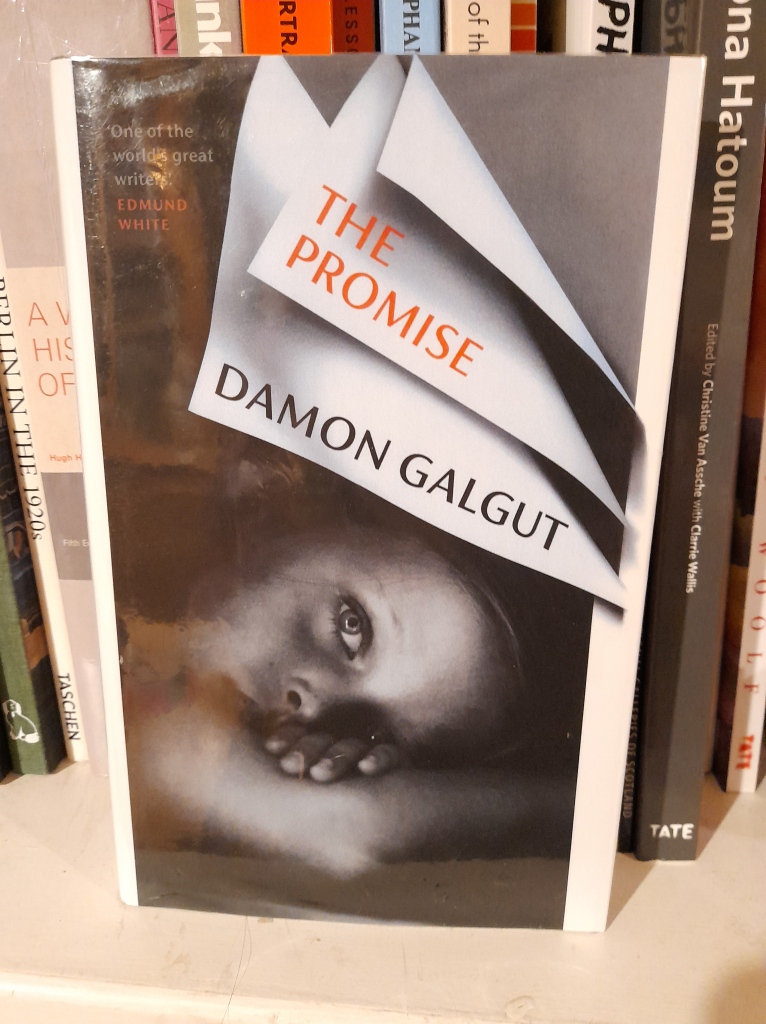
Damon Galgut’s outstanding 2021 novel The Promise was, for me, a worthy winner of the Booker prize, and is definitely one of my top reads of 2021, though to describe the book as a ‘family saga’ – as many reviews have done – is reductive. The book rises way beyond the banal expectations that those two words might conjure up.
The book opens with the untimely death from cancer of Ma, 40-year-old Rachel, who leaves a husband, two adolescent daughters – inscrutable Amor and flighty Astrid – and a slightly older son, the impulsive and sensitive Anton (my favourite). All of these people are complex and flawed to a greater or lesser degree, but all feel like fully rounded, real people. And in the background is the quiet presence of Salome, the family’s black domestic servant, and an unfulfilled promise, made at Ma’s deathbed, of the right to her own home, her own property.
The narrative follows this wealthy, property- and land-rich white South African family and their declining fortunes over a period of about 30 years, covering the time immediately before and the decades immediately following the collapse of apartheid.
The novel is cleverly structured in four parts, each part based around a different funeral, which enables the narrative to leave the main characters frozen at one snapshot moment in time, before cutting forward chronologically to the next significant point of crisis and connection.
There are serious issues here, not least endemic racism, and a revolving backdrop of riots, Presidents and political trials, but the narrative bounces along with a sense of fatalistic glee. The book is never bland, predictable or slow: Galgut has a unique narrative voice, and this work is at once highly literary and grittily down-to-earth in its prose style, while the story confidently balances bleak humour and even some supernatural/magical realist elements without ever over-stretching patience or lapsing into solipsistic self-indulgence. And amid the merry-go-round of death and disappointment (I mean that’s real life, huh?) this an enormously enjoyable book.
I’ll finish with a quote taken from the first page of the book, for flavour:
“It hasn’t happened, not actually. And especially not to Ma, who will always, always be alive.
I’m sorry, Miss Starkey says again, covering her big teeth behind thin, pressed-together lips. Some of the other girls say Miss Starkey is a lesbian, but it’s hard to imagine her doing anything sexy with anyone. Or maybe she did once and has been permanently disgusted ever since. It’s a sorrow we all have to bear, she adds in a serious voice, while Tannie Marina trembles and dabs at her eyes with a tissue, though she has always looked down on Ma and doesn’t care at all that she’s dead, even if she isn’t.“


 Imogen is Reading and Watching the World: On Books, Film, Art & More